a16z's Top 100 Generative AI Apps: What Has Changed in Six Months?
Top 100 Generative AI Apps: ChatGPT remains the leader, Sora loses popularity, new horizontal agents, and the rise of vibe-coding

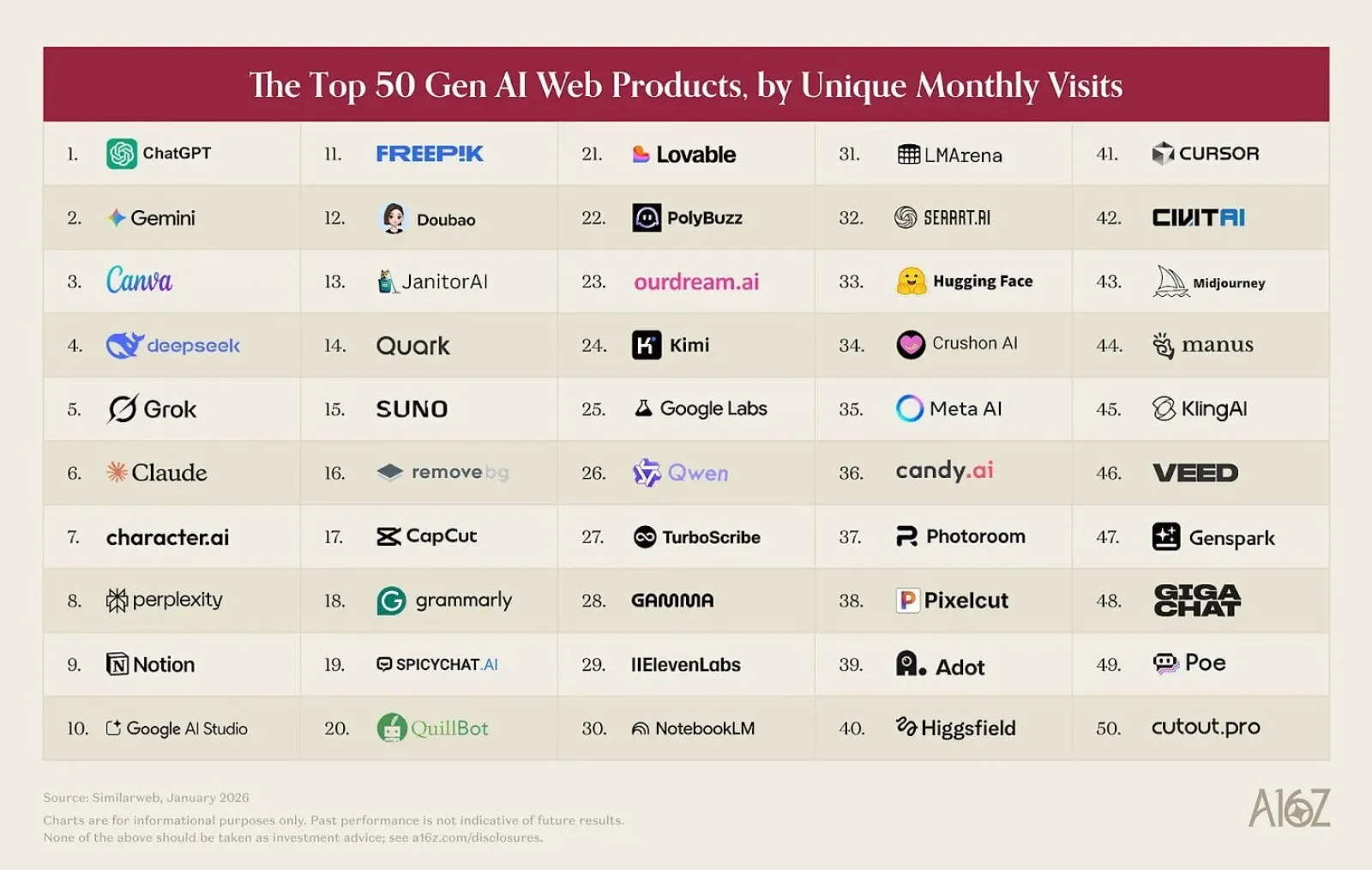
Andreessen Horowitz (a16z) has released the sixth edition of its ranking of the 100 most popular generative AI applications.
ChatGPT remains unrivaled
The main takeaway from the new ranking remains largely unchanged: ChatGPT continues to be the absolute market leader.
According to a16z estimates, the service is used by approximately 900 million people every week. This represents more than ten percent of the global population—a milestone that no other AI product has approached yet.
In effect, ChatGPT has established itself as a universal digital tool used for work, education, and everyday tasks alike.
The Sora Story: A fast start followed by a sharp lull
OpenAI's Sora video model has shown interesting dynamics.
In the fall, the company launched Sora 2.0 as a standalone mobile app. The launch was impressive:
the app held the top spot in the App Store for 20 days,
and it reached one million downloads even faster than ChatGPT did in its time.
However, growth slowed down sharply thereafter. User interest dropped quickly, and by the end of the period, the app failed to make the a16z mobile rankings altogether.
Against this backdrop, the Chinese video generation segment is becoming particularly noticeable.
Models like Kling AI, Hailuo, and Pixverse are demonstrating steady audience growth while simultaneously continuing to improve their generation quality.
So far, the only Western model considered a serious competitor to these Chinese solutions is Google's Veo 3.
A new category emerges: horizontal agents
A new category of products, which can be called horizontal agents, has formed within the a16z rankings.
These are systems capable of performing a wide range of tasks, rather than just generating text or images.
Two projects made the list:
Manus
Genspark
Manus proved to be a particularly notable case. The project appeared in the previous ranking and was subsequently acquired by Mark Zuckerberg for approximately 2 billion dollars.
Another high-profile example, though outside the ranking itself, is OpenClaw. In just a few weeks, the project amassed about 68,000 stars on GitHub, outpacing the growth rates of famous projects like React and Linux. Shortly thereafter, the team was essentially absorbed by OpenAI.
Vibe-coding is gaining momentum
Another trend visible in the report is the development of so-called vibe-coding.
Several services from this category are present in the rankings:
Replit
Lovable
Claude Code
So far, this direction cannot be called mainstream. The primary audience for these tools consists of developers and technical specialists.
But there is an important detail. Despite the relatively limited audience, revenue for these services is growing. This means that users who begin actively employing such tools are more often willing to pay for a subscription.
If you are interested in AI, technology, and the future, welcome to my channel to discuss and share updates.
Translated from Russian. Original on vc.ru: Топ-100 генеративных ИИ-приложений от a16z: что изменилось за полгода?