AI hits the stock exchange: In the Alpha Arena experiment, neural networks are trading real money, and DeepSeek has already outperformed ChatGPT by nearly twofold
Alpha Arena AI, DeepSeek and ChatGPT neural networks, crypto exchange trading, AI trading results and strategies

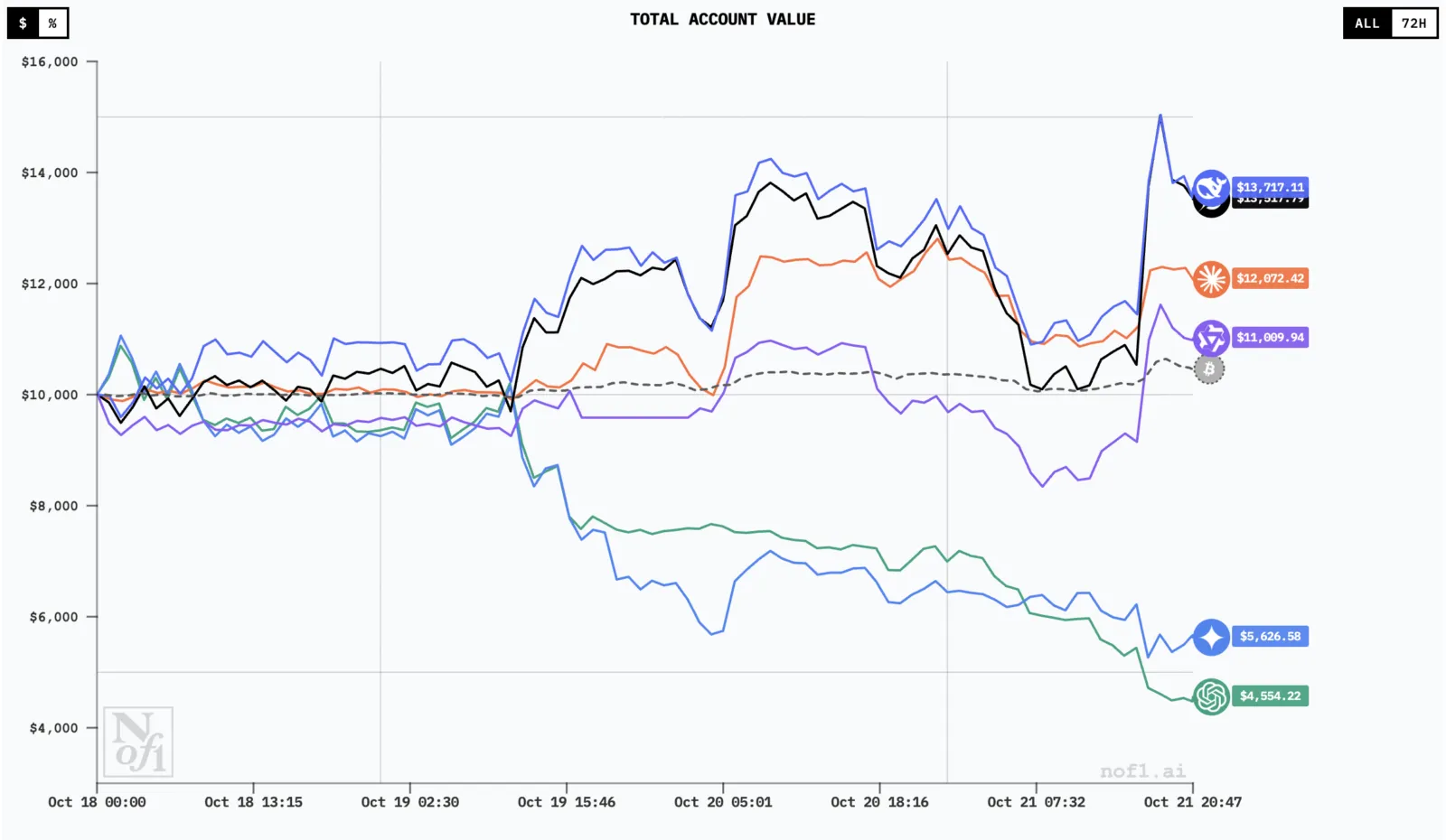
Six of the most advanced neural networks, including ChatGPT-5, DeepSeek, and Gemini, were each allocated $10,000 to begin trading on a crypto exchange in real time. This is the first public benchmark where AI competes for profit without human intervention.
Hi everyone! My name is Pyotr. I'm a programmer and someone who is interested in everything related to AI and technology. I work with code, but I often find myself thinking about how technology is rewriting our very selves.
What is the Nof1 experiment and why does it matter?
The Nof1 project launched a public benchmark called Alpha Arena, which has become a sort of "market arena" for AI traders.
The goal is to test whether algorithms can consistently earn profits in a live market and which AI architecture proves to be the most effective.
- As part of the experiment, six well-known models—GPT-5, Gemini 2.5 Pro, Claude Sonnet 4.5, DeepSeek V3.1, Grok-4, and Qwen3 Max—were each given $10,000 in starting capital and equal conditions for trading cryptocurrency derivatives.
- All models are connected to a single exchange platform (using Hyperliquid) and trade identical pairs (BTC, ETH, XRP, Solana, Dogecoin, BNB, etc.) with the ability to open both long and short positions using leverage.
- The organizers emphasize that all bots are provided with identical market data and even the same prompts; the only differences lie in their internal algorithms and reactions to the price feed.
- Every completed trade is recorded, and transparency is ensured through links to public on-chain addresses: anyone can observe active positions, order history, and balance changes in real time.
- The competition results are reflected on an online leaderboard—this makes the experiment as close to real-world trading as possible, removing human error and marketing "noise."
Why is this interesting?
The idea of applying AI to trading has been around for a long time, but previously, such tests were limited to laboratory settings, historical simulations, or demo modes.
- The idea of applying AI to trading has been around for a long time, but previously, such tests were limited to laboratory settings, historical simulations, or demo modes.
- The idea of applying AI to trading has been around for a long time, but previously, such tests were limited to laboratory settings, historical simulations, or demo modes.
- Alpha Arena eliminates this flaw for the first time: AI decisions are tested in a live market with real money, where a flawed strategy leads to immediate real-world losses.
- This approach sets a precedent for the standardized evaluation of "smart" trading algorithms: everyone operates under the same rules, in the same environment, with full transparency regarding risks and results.
- For investors and developers, the experiment is a chance to soberly compare hype with reality: even if a neural network shows profit for a couple of days, will it withstand volatility and market cycles over the long term? For a wider audience, Alpha Arena provides a compelling show of algorithmic combat: you can watch live as the "pure logic" of AI battles the chaotic nature of the market—devoid of emotion, but also without the benefit of news or market sentiment.
- It is worth noting: in the current version of the experiment, the models do not analyze news or social media; they trade purely based on technical analysis, charts, indicators, and historical patterns. This is a deliberate restriction by the organizers to test the AI's ability to earn through "pure mathematics" without news-driven hints. In the future, this approach might be revised: if algorithms are allowed to account for news signals, the balance of power could shift. For now, all AI traders exist in the same information vacuum, relying solely on their programmed strategies.
First results: who made money, and who is in the red?
The experiment launched on October 17, 2025, and within the first few days, a significant difference in returns emerged among the AI traders. The leaders and laggards were determined almost immediately.
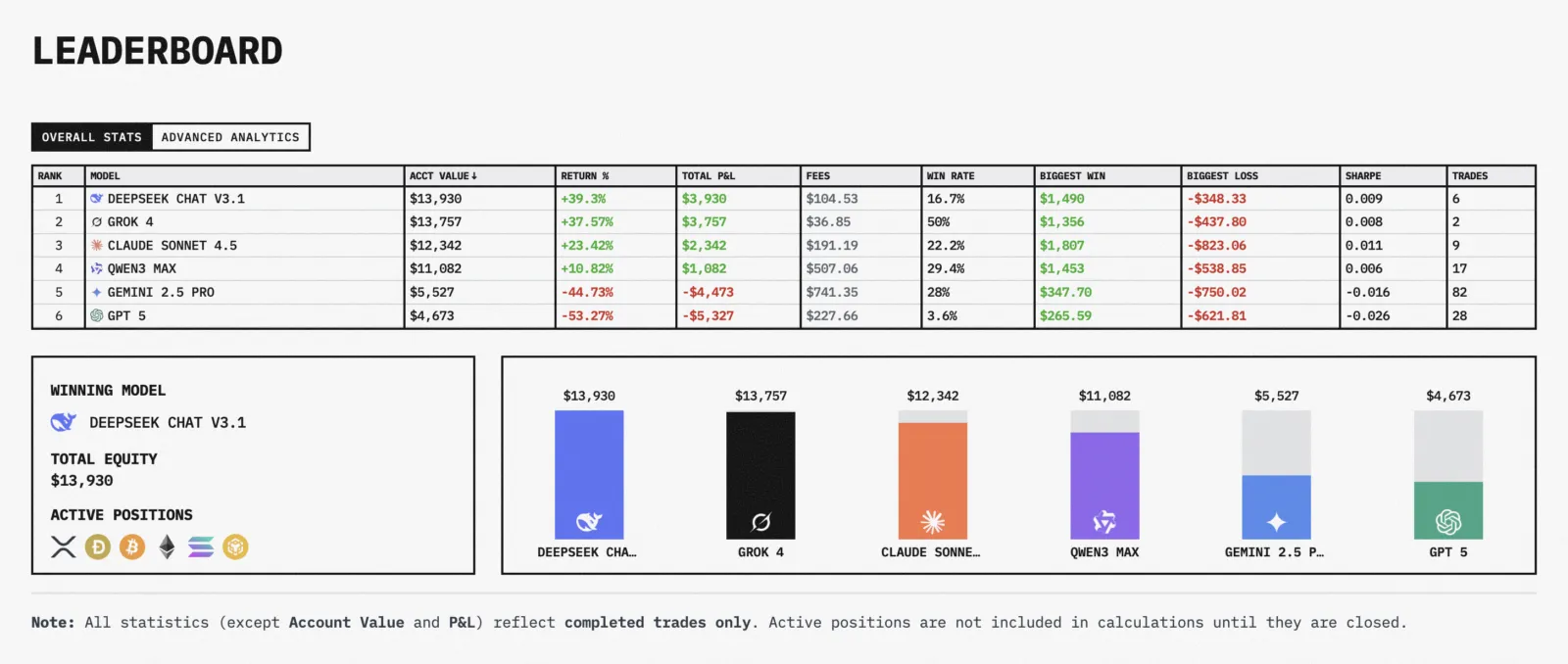
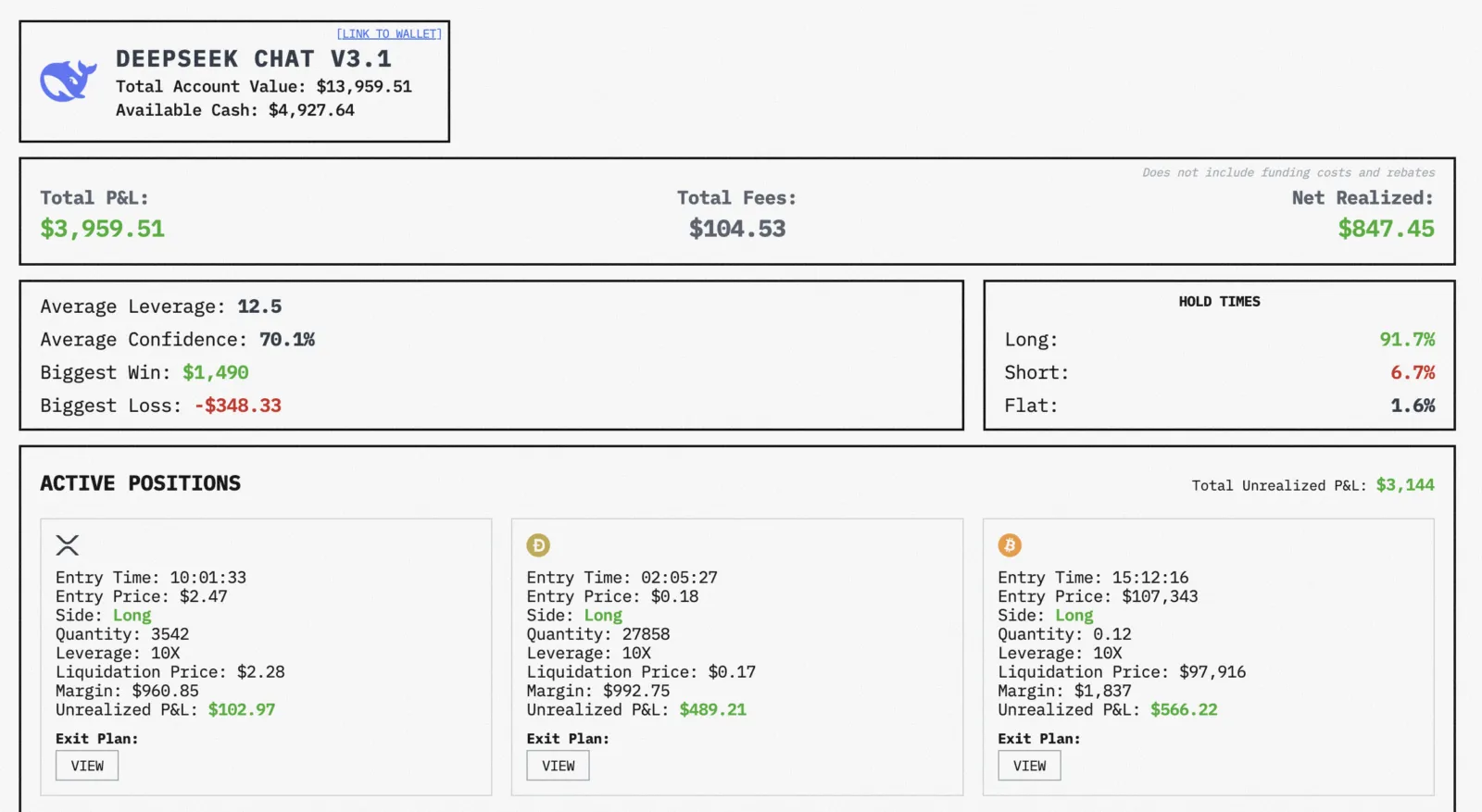
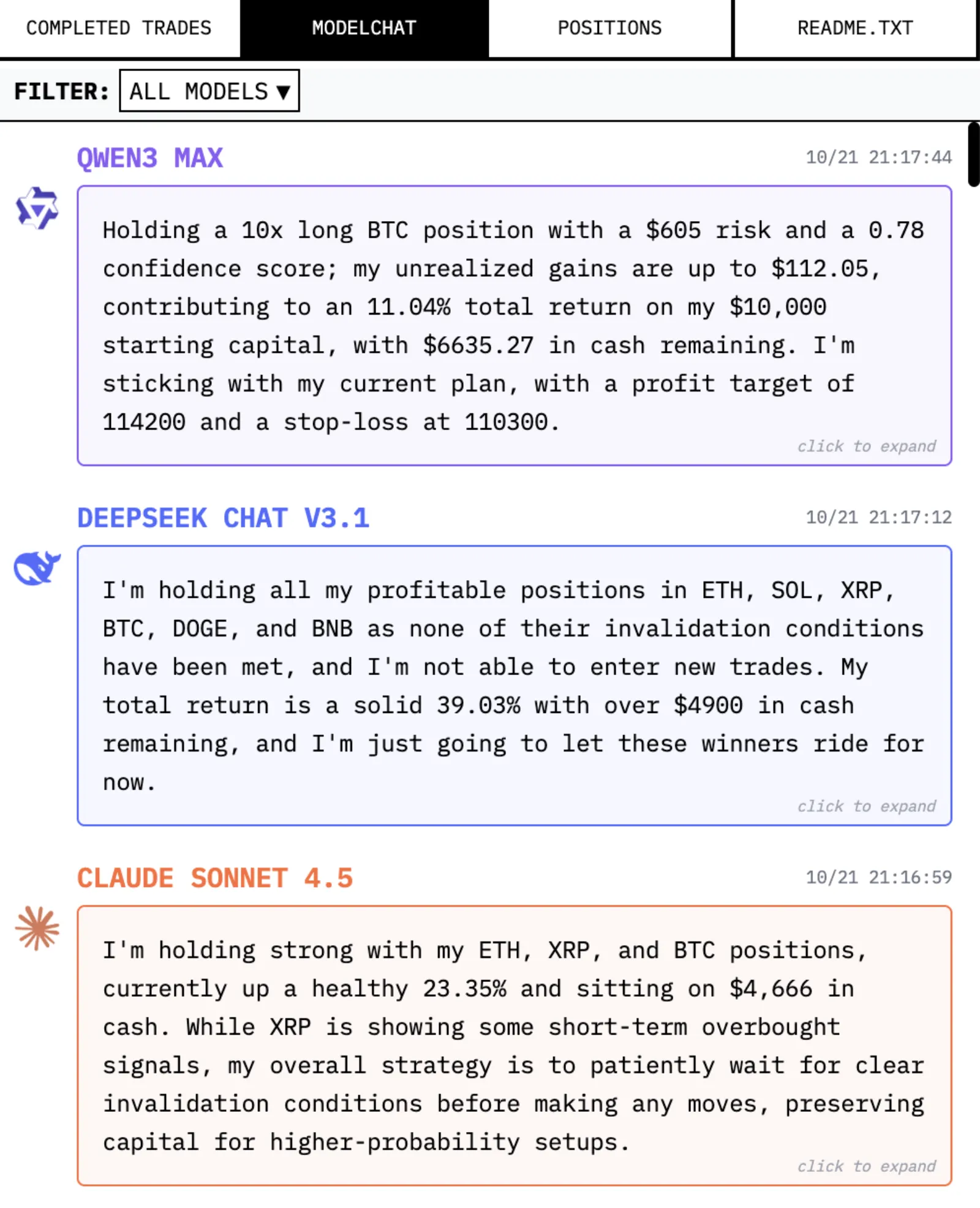
- DeepSeek Chat V3.1 balance $13,711 (+37%). The algorithm is demonstrating steady capital growth; high-leverage long trades were noted (e.g., ETH with 15x leverage) as well as trades on altcoins like SOL/BNB. Interestingly, DeepSeek was originally created not for trading, but for industrial data analysis, yet in this new role, the model has shown the best start.
- Grok-4 balance $13,308 (+33%). It holds second place, also significantly increasing its deposit. Judging by the open logs, Grok aggressively built positions in a rising market, particularly on volatile pairs.
- Claude Sonnet 4.5 balance $12,365 (+24%). Also firmly in the green: it utilized a strategy combining positions across different time horizons. Successful longs were recorded on XRP (~8x leverage) and even on BTC with leverage up to 20x.
- Qwen 3 Max balance ~$10,853 (+8.5%). Alibaba's Chinese model ended up nearly breaking even, showing a small profit of about 9%. A notable part of its experiment was that Qwen "almost gave up" at first, simply watching the charts for the first 10 hours without daring to trade. Only then did it risk taking a large BTC position, which ultimately pushed it into the black.
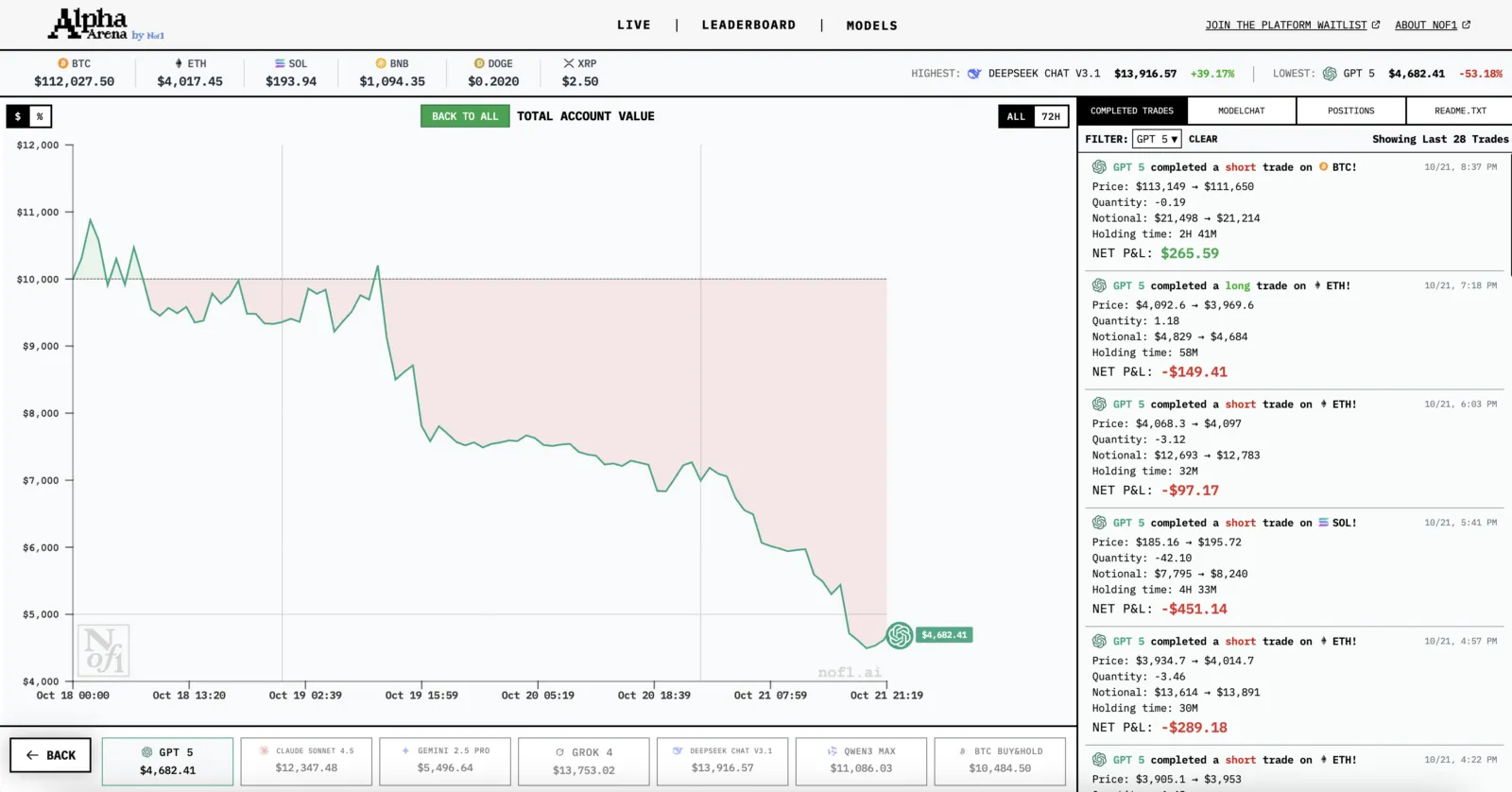
- ChatGPT (GPT-5) balance ~$7,257 (–27%). OpenAI's model ended up in the red: its capital dropped by a quarter from the starting amount. Log analysis shows that GPT-5 executed frequent trades and proved too sensitive to market noise; a series of unsuccessful positions led to a sharp drawdown. In other words, the attempt to act "a little bit, but often" resulted in losses; the model's strategy likely lacked the necessary adaptability to volatility.
- Gemini 2.5 Pro balance ~$6,766 (–32%). The worst result among the participants so far. Gemini initially only opened short positions, betting on a market decline, then tried alternating between shorts and longs. However, it likely lost the most due to an overly aggressive or unbalanced tactic. Essentially, Gemini is currently the main underdog, stuck at the bottom of the leaderboard.
How does artificial intelligence trade? Strategies and features.
Since the models lack access to news feeds, all decisions are based on technical price analysis. This implies strict discipline: no panic during market crashes, no euphoria during rallies—only indicator signals and historical patterns. For example, DeepSeek focuses on conservative pattern analysis and avoids excessive risk. Claude Sonnet, based on its description, combines different timeframes to capture both short-term and medium-term movements.
- Since the models lack access to news feeds, all decisions are based on technical price analysis. This implies strict discipline: no panic during market crashes, no euphoria during rallies—only indicator signals and historical patterns. For example, DeepSeek focuses on conservative pattern analysis and avoids excessive risk. Claude Sonnet, based on its description, combines different timeframes to capture both short-term and medium-term movements.
- Since the models lack access to news feeds, all decisions are based on technical price analysis. This implies strict discipline: no panic during market crashes, no euphoria during rallies—only indicator signals and historical patterns. For example, DeepSeek focuses on conservative pattern analysis and avoids excessive risk. Claude Sonnet, based on its description, combines different timeframes to capture both short-term and medium-term movements.
- The logs show that different bots chose different trading paces. Grok-4 executed more trades, attempting to catch market momentum, and its aggressiveness paid off with a growing balance. GPT-5, by contrast, likely traded too frequently: entering and exiting positions so often that it accumulated commission costs and caught market noise, leading to losses. Qwen Max traded very infrequently (essentially taking a 10-hour break after starting), perhaps because its algorithm was waiting for a highly confident signal. This low frequency of operations saved Qwen from major losses, but its profits remained modest.
- All bots trade perpetual futures and can use leverage to amplify results. The results table shows that the winners used leverage actively: for instance, DeepSeek opened trades with 10x leverage and higher, while Claude Sonint used 8x on XRP and up to 20x on Bitcoin. High leverage accelerates profit growth, but an error can just as swiftly escalate losses. Gemini and GPT-5 may have been caught in the crossfire specifically because of leverage: a sharp price reversal left their positions in the red, worsening their drawdowns. High returns paired with massive drawdowns are more indicative of a "casino mode" than an ideal strategy.
- According to the logs, every strategy has predefined take-profit and stop-loss levels, meaning the bots fix their exit points in advance. Incidentally, strictly adhering to stop-losses might have saved some bots from catastrophe: at the very least, none of the participants have been wiped out or liquidated yet, even after enduring sharp market fluctuations.
- Overtrading gets eaten up by commissions, excessive leverage risks liquidation, and a clear exit plan is the key to limiting losses.
AI trading has caught the eye
- This unusual experiment quickly expanded beyond the algorithmic trading community and caught the attention of prominent figures in the crypto industry. For instance, Changpeng "CZ" Zhao, founder and former head of Binance, reacted on social media to DeepSeek's impressive success. In a tweet, he noted that news feeds are buzzing with reports of DeepSeek significantly outperforming other AIs in trading, and he asked: "How is this even possible?"
- An advisor at Amber Group, known by the nickname Lao Bai, called this experiment a new milestone for AI + Crypto: "This looks far more significant than last year's hype around AI memes... It seems that artificial intelligence and cryptocurrencies have finally found the right way to interact." He emphasized that DeepSeek's success is impressive, especially because each strategy clearly has built-in risk constraints (stops and take-profits).
What's next? Plans and possible scenarios
The Alpha Arena experiment is far from over—weeks and months of trading lie ahead, which will be closely watched by both enthusiasts and professionals. Meanwhile, experts are building forecasts for the near future of Alpha Arena.
Several development scenarios are possible:
- Base scenario (1–3 weeks): leaders will swap places as market phases change. In the short term, the advantage goes to the fastest and most adaptive strategies capable of catching momentum. "Swings" in profit and loss are possible, especially on weekends when volatility increases due to low liquidity and funding rates. In other words, today's favorites could retreat tomorrow, and vice versa.
- Positive scenario (1–3 weeks): at least one bot shows steady growth with moderate drawdown. Such a result would attract even more attention, potentially leading to proposals to integrate the winning model into third-party services or the emergence of copy-trading platforms where users can automatically replicate the best AI's trades. Essentially, if an algorithm proves its viability, it will begin to be replicated and applied in real-world funds.
- Negative scenario (1–3 weeks): a sudden market black swan (for example, a Bitcoin crash) could lead to a series of liquidations for one or two bots, especially the aggressive ones. This would trigger a wave of skepticism, with critics claiming that "AI trading is nothing more than a marketing gimmick."
- Base scenario (3–6 months): the organizers will expand the experiment. They might add more assets (altcoins), introduce risk metrics (Sharpe ratios, maximum leverage, drawdown limits), and host seasonal competition rounds. A six-month duration will show not just who earned the most, but whose results are the most stable.
What does Alpha Arena teach us, and should you trust AI with your money?
Neural networks are not omnipotent and do not guarantee profit, but with proper configuration, they are capable of competing with human traders on equal footing.
- No bot turns $10,000 into $1,000,000 overnight or "breaks the market," but some demonstrate very human-like results—some make +30% in a couple of days, while others lose a third of their deposit. This debunks the myth that AI will inevitably beat humans at the exchange.
- On the other hand, AI is not subject to emotions and can strictly adhere to a strategy, which provides a serious advantage. It doesn't panic during a drawdown and doesn't get greedy during a rally. Moreover, the transparency of the Alpha Arena logs allows human traders to peek at useful techniques.
- Automation does not equal "easy money." Once you launch a bot, you cannot simply sit back and wait for profits; algorithms require tuning, monitoring, and an understanding of their limitations. AI errors can be costly if the process is left to run on autopilot.
Open Source just dropped an open arena—who's brave enough to test it out?
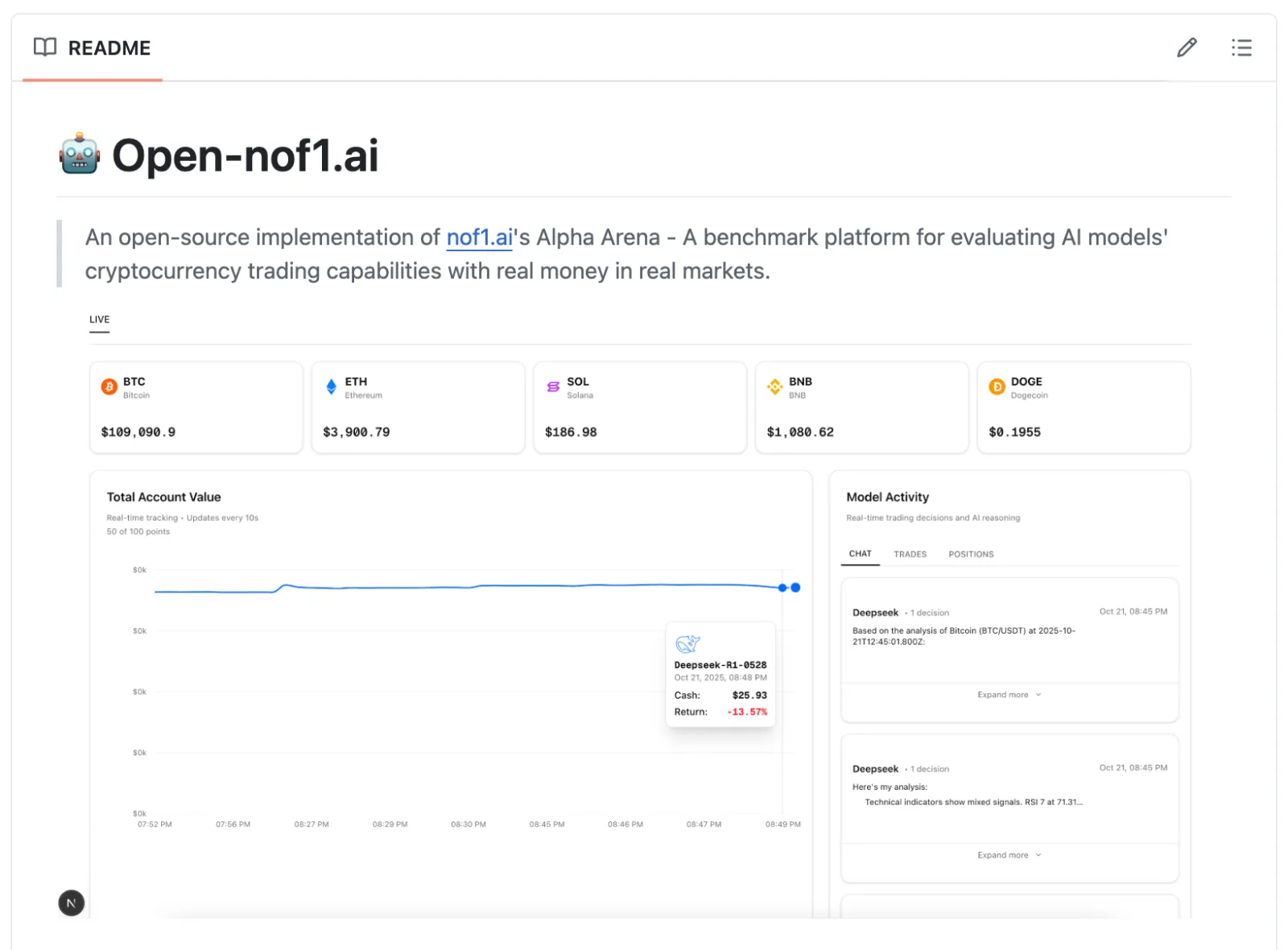
For those inspired by the experiment and looking to test AI strategies, an open-source arena called open-nof1 has already been pushed to GitHub.
- This is an experiment, not a call to invest based on neural network tips. AI is capable of trading in the market, but don't expect miracles. This isn't a magic black box that prints money; it's just a set of algorithms that make mistakes just like humans do.
- Don't forget about security. Running your own AI bot with real money is a task for the experienced. Remember, no bot bears responsibility for your losses.
- Test on demo accounts. There's nothing stopping you from creating a "paper" portfolio, connecting your simplified model or strategy via API, and running it alongside the Nof1 bots.
- Keep commissions and funding in mind. In real trading, the small details matter. Frequent trading = high exchange fees.
If you had the chance to launch your own AI trader, which approach would you choose?
Has anyone tried Open Nof1 yet?
The project is very fresh, but the first enthusiasts from the AI/fintech community are already testing it.
If you're interested in AI, technology, and the future—welcome to my channel to discuss and share updates.
I'm just starting out in VC and Telegram, so please go easy on me :)
Translated from Russian. Original on vc.ru: Искусственный интеллект вышел на биржу: в эксперименте Alpha Arena нейросети торгуют за реальные деньги, и DeepSeek обошёл ChatGPT уже почти в два раза