Anthropic just released Opus 4.7. What has actually changed?
Opus 4.7 is more stable in agentic scenarios, coding performance has improved, it loses context less frequently, and it performs tasks better without supervision.

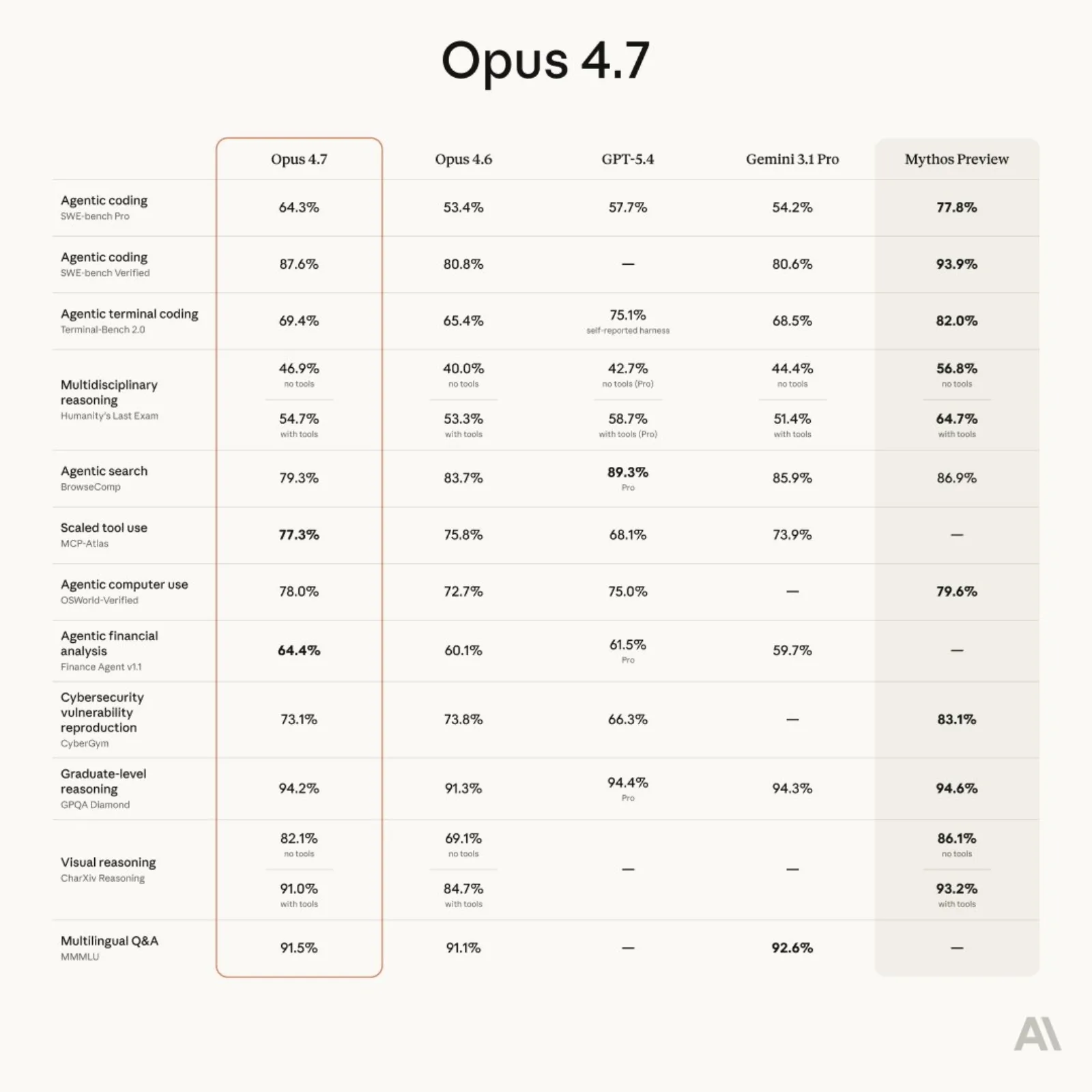
The model doesn't just leap ahead in a single metric; instead, it improves across almost all areas, which is more important for real-world work than breaking records.
The Key Change
Opus 4.7 has become more stable in agentic scenarios, as evidenced by its growth in SWE Bench Pro to 64.3% compared to 50.4% for 4.6, and in Terminal Bench, where the model handles tasks in tool-based environments better. This directly impacts how long it can be kept in an autonomous loop without intervention.
The model loses context less often, breaks the chain of actions less frequently, and is better at completing tasks without reinventing steps.
Coding and Tool Use
The increase to 87.6% in SWE Bench Verified means the model doesn't just suggest solutions; it more frequently reaches a valid result that passes checks rather than requiring manual refinement.
Logic and Complex Tasks
The improvement in reasoning tasks is moderate but significant. The model remains at the level of the top performers, but it has become more stable both with and without tools, meaning fewer quality fluctuations within a single session.
Where does it fall short?
Mythos remains ahead in several benchmarks, especially in agentic coding and reasoning, where figures reach 77–93%. However, this is expected, as its strategy focuses on maximizing peak performance rather than achieving balance.
GPT-5.4 and Gemini also score higher in certain areas, such as agentic search, but these are specific use cases that don't always reflect real-world production workloads.
What does this mean in practice?
Opus 4.7 can be kept in a loop longer without constant supervision because it follows instructions better, takes illogical steps less often, and more frequently validates results before outputting them.
This reduces the need for manual checks, decreases the number of iterations, and makes the model more suitable for automation rather than just for generating responses.
Translated from Russian. Original on vc.ru: Anthropic только что выпустили Opus 4.7, что изменилось на практике?


