Anthropic shows how to cut AI agent costs by 3x: expensive models shouldn't do all the work themselves
Multi-agent architecture, AI agent cost savings, big data processing, document analysis, high-speed information processing

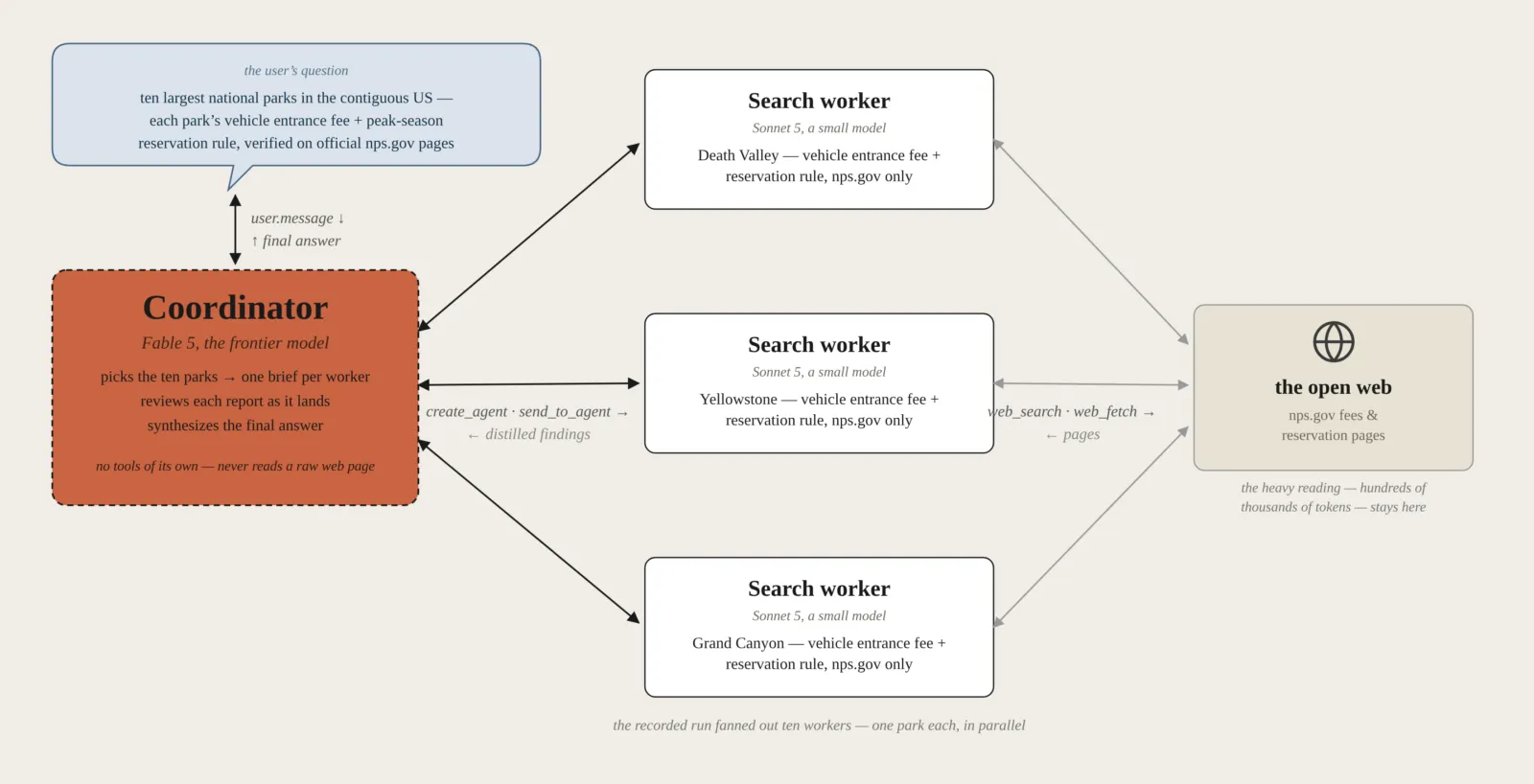
The proposed approach involves splitting tasks between two model tiers. A powerful LLM handles planning, task delegation, and final response assembly, while cheaper models take over all the routine work: searching for information, reading documents, and preparing brief summaries.
According to test results, this approach proved to be approximately 2.5x cheaper and nearly 3x faster than using a single large model for the entire process.
Why does this work?
Virtually any AI agent performs two completely different types of tasks.
The first requires a high level of intelligence. It involves understanding the user's request, devising a solution strategy, breaking the work into parts, and then synthesizing the results.
The second is much simpler. It involves reading hundreds of pages of documents, searching the web, fact-checking, reviewing logs, and analyzing large volumes of text. In this stage, the model primarily spends a massive amount of tokens on mechanical data processing.
This is precisely the part that is most often the most expensive today.
A Two-Tier Architecture
At the top sits a coordinator powered by a flagship model. It has no search tools at all; its only job is to think.
It receives the user's request, breaks it down into small, independent tasks, and sends them to worker agents.
The worker agents use a cheaper model. They are the ones with access to search, opening websites, reading documents, gathering facts, and returning short reports to the coordinator.
The National Parks Experiment
The goal was to verify the entry costs and mandatory reservation requirements for the ten largest US national parks. Every fact had to be verified using only official pages.
To do this, the coordinator launched ten worker agents simultaneously. Each agent investigated only one park.
The company then repeated the same experiment using a single agent running on a flagship model, which performed the entire job on its own.
The results were telling.
The multi-agent system finished the research in approximately 194 seconds, whereas the single agent took about 608 seconds.
The execution cost also differed significantly.
- Multi-agent scheme: $1.61
- Single agent: $4.00
Furthermore, about 84% of all input tokens were processed by the cheaper worker models.
Where are the savings maximized?
This approach works particularly well for tasks involving large-scale information processing.
For example:
- web searching;
- analyzing large documents;
- fact-checking;
- log auditing;
- researching large codebases;
- preparing summaries from multiple sources.
In all these scenarios, the primary cost stems from the volume of text read, rather than the complexity of reasoning.
When won't this scheme help?
If the task is small, setting up multiple agents might end up being more expensive than a standard model call.
If deep analysis of the document itself is required, rather than just fact extraction, using a cheap model might lead to the loss of important details.
Additionally, efficiency depends on proper task decomposition. In one experiment, researchers found that the model failed at the very first step of identifying the list of the largest parks. While all subsequent facts were meticulously verified, the initial premise was incorrect. Therefore, it is sometimes worth assigning a separate agent even to verify the initial hypothesis.
If you are interested in the technical details, code, and implementation of this multi-agent scheme, you can check it out here: CMA_plan_big_execute_small.ipynb
Translated from Russian. Original on vc.ru: Anthropic показала, как сократить расходы на ИИ-агентов в 3 раза: дорогие модели не должны выполнять всю работу самостоятельно