Battle of the Titans: How Google TITANS and MIRAS are Changing the Approach to AI Memory?
Google TITANS and MIRAS propose a new AI memory architecture: long-term memory, knowledge integration, user adaptation, and improved assistant performance.

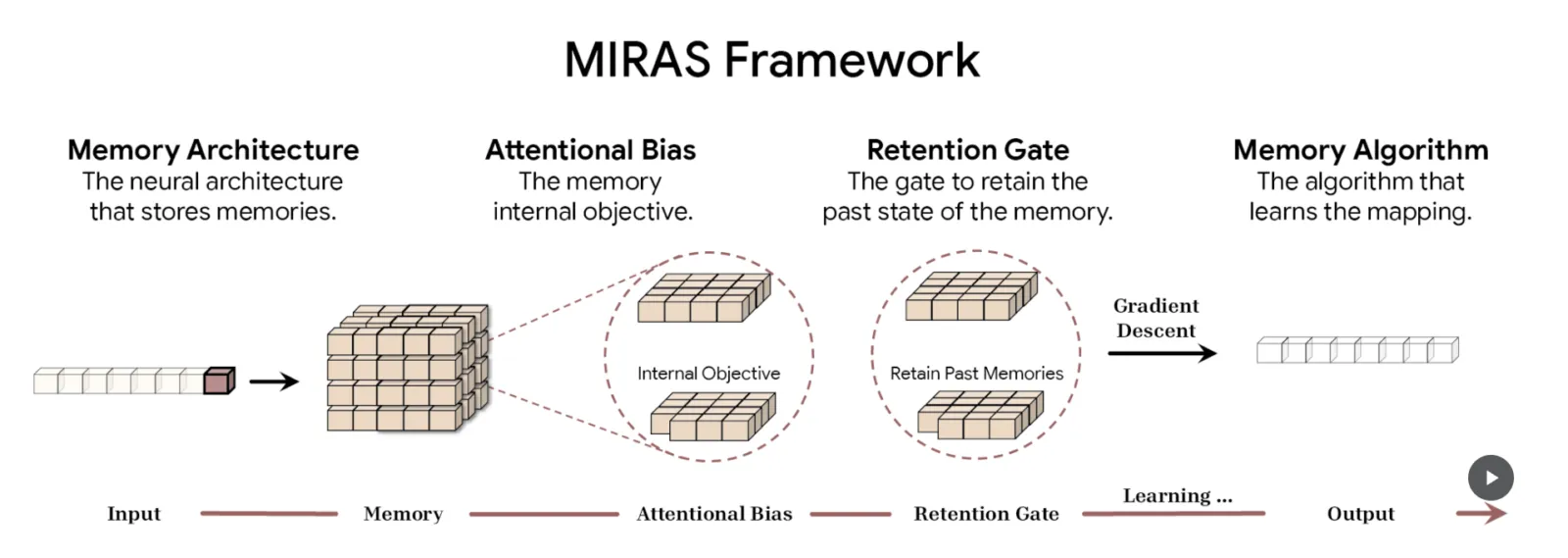
Today, AI memory has the capacity of a goldfish. It relies on limited context windows and synthetic hacks like RAG. TITANS and MIRAS offer, for the first time, an architecture that makes memory an inherent, trainable mechanism rather than an external crutch.
Google has introduced the TITANS and MIRAS research, which proposes a new approach to building long-term memory for Large Language Models. This work addresses one of AI's key challenges: the lack of true long-term memory, which often causes models to lose context, fail to maintain continuous workflows, and struggle to work with a user's long-term knowledge base.
What is TITANS?
TITANS, or Training Inference Trajectory Aware Network, is an architecture that maintains a model's operational history, allowing it to adapt to tasks that unfold over time.
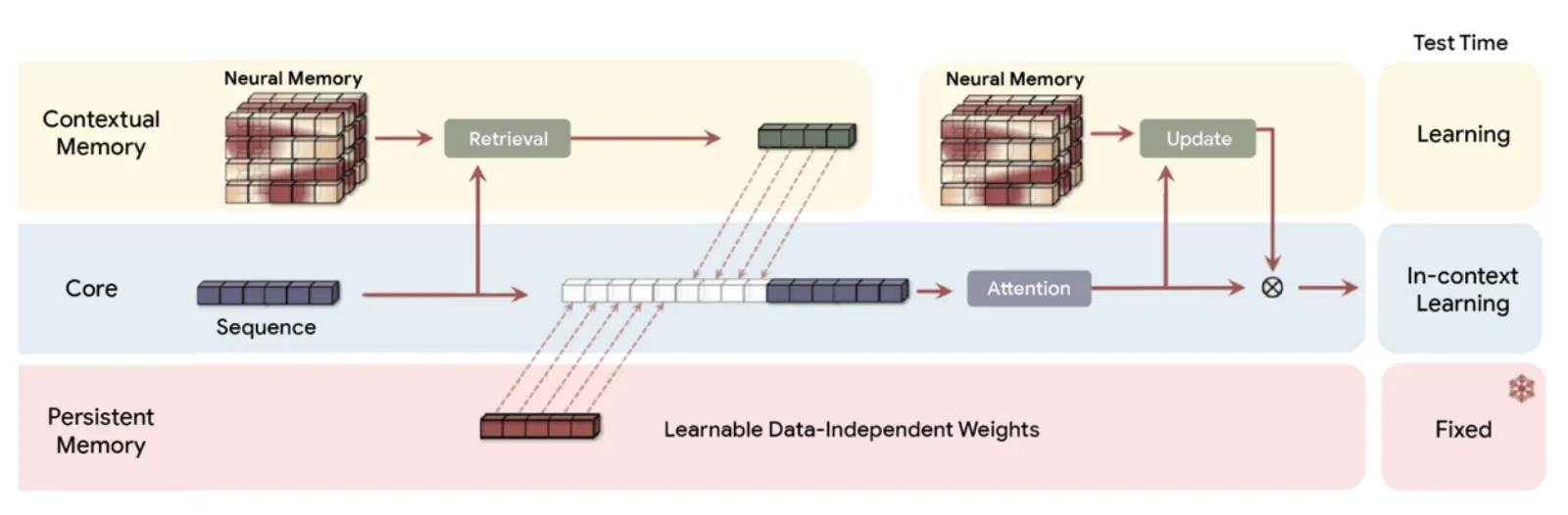
The core idea is that the model sees not just the current state of a dialogue or task, but the trajectory that led to it. This brings AI closer to how humans form memories and make decisions. We rely not just on a fact, but on the path that brought us to that fact.
For businesses, this means a new generation of assistants that truly remember the user. For example, a product assistant could remember not just query history, but the user's way of thinking; corporate AI could track the evolution of projects and decisions within a team, and so on.
What is MIRAS?
MIRAS, or Memory Inference Rewriting Augmentation System, is a mechanism that allows a model to do more than just store data—it can rewrite and update its memory during operation. This is a major step toward autonomous agents with a cohesive world model.
Today, we rely on external RAG databases. MIRAS makes memory a part of the model itself. It filters, consolidates, and updates knowledge much like our own brains do. This is effectively the first architecture that allows AI to possess coherent knowledge regarding long-term tasks.
Key Features of MIRAS
Selecting significant data, eliminating redundancies, correcting outdated information, updating facts based on new signals, and integrating memory into the model's single cognitive stream.
This makes it possible to have AI that learns from your experience as organically as an intern working alongside you for several months.
Why is this a breakthrough?
Until now, long-term memory in AI has been artificial. Expanding the context window didn't solve the underlying problem. RAG provided access to data but didn't make the model smarter. Fine-tuning allowed for training, but not for real-time knowledge updates.
TITANS and MIRAS provide the following:
- a full cognitive trajectory
- memory update mechanisms
- seamless knowledge integration
- resilience to long reasoning chains
- user adaptation without retraining
Essentially, Google is proposing a transition from generative models to cognitive systems.
How does this change products?
1. Assistants will stop being short-lived
They will be able to remember your projects, preferences, and decision-making styles, providing more accurate and personalized recommendations.
2. AI agents with stable behavior will emerge
In other words, agents that don't change their strategy every five minutes, but rather evolve like humans.
3. Deep corporate knowledge will become more accessible
AI will be able to store the history of decision-making, not just documents.
4. A breakthrough in learning and mentorship
Models will be able to remember a student's developmental dynamics. This is a new level for EdTech.
5. A new type of AI for coding
Development tools will gain memory of architectural patterns, team styles, and repository changes.
What's next?
The next step is integrating this type of architecture into mass-market AI products, ranging from assistants to agentic systems. Major companies are already betting on autonomous task chains and multi-day missions for agents. Without long-term memory, this is impossible.
If you are interested in AI, technology, and the future—welcome to my channel to discuss and share updates.
Translated from Russian. Original on vc.ru: Битва титанов: как Google TITANS и MIRAS меняют подход к памяти ИИ?