Google DeepMind Unveils Gemini Robotics 2.5: Humanoids Learn to Work at Mercedes-Benz Factories with 96% Accuracy
Google DeepMind's Gemini Robotics 2.5, Apollo 2 humanoids at Mercedes-Benz factories, 96% success rate, improved dexterity, part handling, environmental adaptation

The model has significantly improved its ability to handle objects, execute complex sequences of actions, and adapt to its physical surroundings. During testing, the Apollo 2 humanoid sorted automotive parts at Mercedes-Benz production sites in Germany and Hungary, achieving a 96% success rate.
On November 10, 2026, Google DeepMind announced Gemini Robotics 2.5, its most advanced VLA (Vision-Language-Action) model. These systems transform visual information from cameras and textual instructions directly into robotic actions. Instead of a pre-programmed sequence of movements, the machine receives a task, analyzes the environment, and independently determines how to move its arms and grippers.
The new generation is noticeably more precise and faster than its predecessor. According to DeepMind's internal tests, the success rate for various task categories increased by 30–100%, while speed improved by 20–30%. The model was tested on more than 200 different tasks, including working with tools, flexible materials, and fragile objects.
However, the most significant achievement lies not in laboratory tests, but in trials at real automotive manufacturing plants. In collaboration with Apptronik and Mercedes-Benz, researchers tested whether the humanoid is capable of performing useful work directly on an active factory floor.
From packaging pastries to tying bows
One of the most notable improvements in Gemini Robotics 2.5 relates to fine motor skills. The robots have become significantly more confident when handling objects that require precise gripping, finger repositioning, and constant movement adjustments.
In DeepMind's demonstrations, the robot uses tongs to package pastries, ties a bow on a gift box, folds clothes, and performs laboratory manipulations with a pipette. Such actions seem simple to a human but present a serious challenge for robotics. Soft materials change shape, small objects can slip from a grip, and the exact position of an object cannot be determined by pre-set coordinates alone.
Results from individual tests show the scale of this progress. Packaging pastries with tongs now succeeds in 100% of attempts, compared to 5% for Gemini Robotics 2. Closing a tool drawer lid reached a 93% success rate, whereas the previous version failed the task. Folding trousers improved from zero to 40%, and untying a bow went from zero to 70%.
It is important to note that these are results from specific DeepMind tests, not a guarantee of the robot's reliability in any condition. For instance, a 40% success rate in folding trousers represents significant progress over the previous model, but such a figure is still insufficient for practical application.
Apollo 2 Humanoids Deployed at Mercedes-Benz Factories
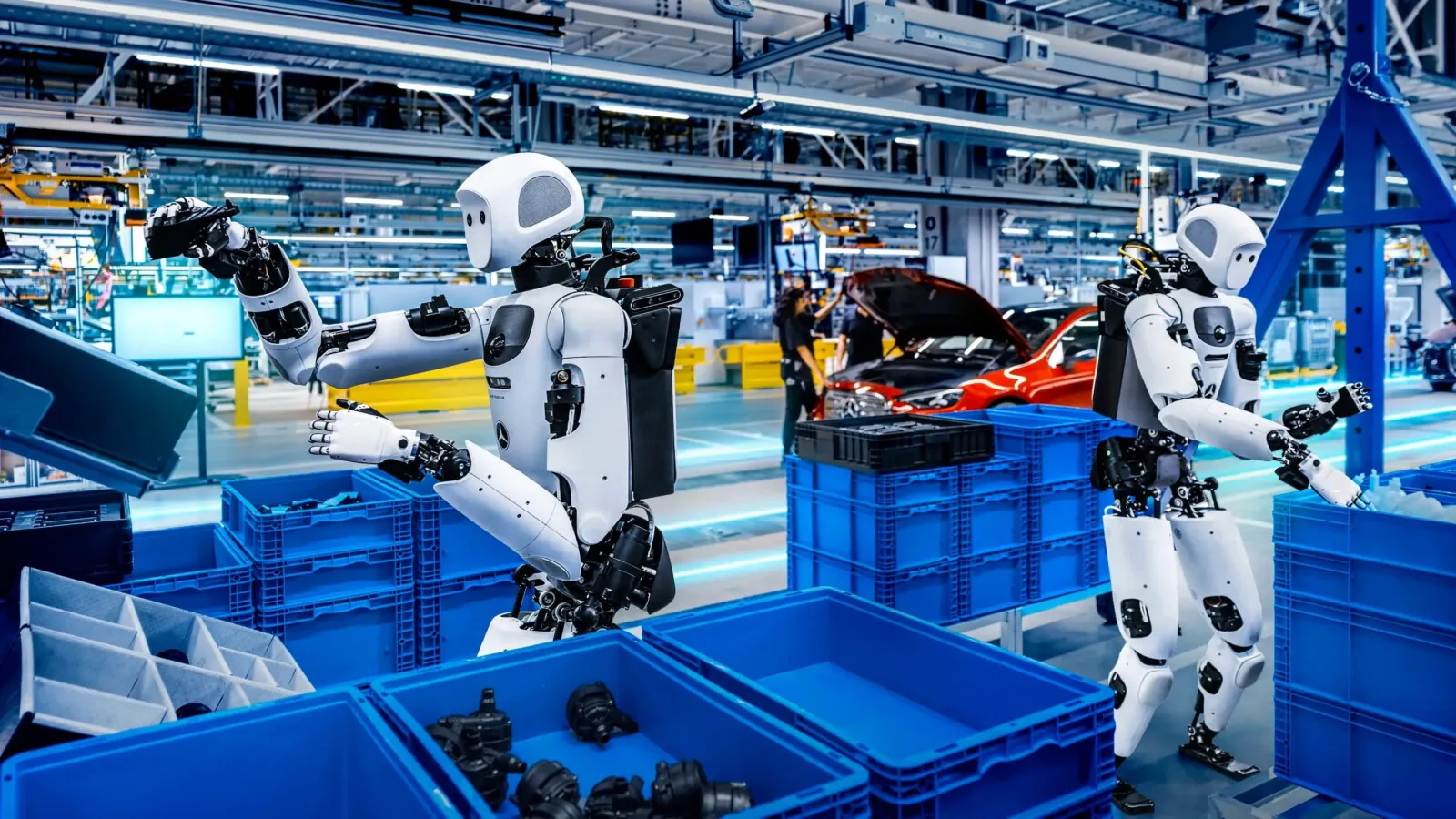
The most critical test took place on active production lines at Mercedes-Benz in Kecskemét, Hungary, and Sindelfingen, Germany. The experiment utilized Apollo 2 humanoid robots from the American company Apptronik, equipped with Google DeepMind's control system.
The robots were assigned the automotive kitting task—preparing sets of parts for subsequent vehicle assembly. Apollo 2 had to retrieve metal brackets from shared containers and arrange them into specific trays in a sequence that matches the needs of the production line.
While this work may seem monotonous, it requires constant environmental analysis. Parts may lie at different angles, overlap, or be located somewhere unexpected. The robot must recognize the correct component, grasp it properly, move it to the appropriate cell, and adjust its actions if the situation changes.
Two models were used to perform the task. Gemini Robotics ER was responsible for environmental understanding, operation sequencing, and planning. Gemini Robotics 2.5 directly controlled the movements of the arms and grippers.
According to Google DeepMind, the success rate of the operation reached 96%. The company views the experiment as a proof of concept, demonstrating the potential of humanoids for industrial applications.
However, this figure requires context. DeepMind did not disclose the total number of attempts, the duration of continuous operation, the frequency of operator intervention, or the exact definition of a successful operation. Therefore, the pilot results cannot yet be directly extrapolated to a full factory shift or evaluated as readiness for mass deployment.
One AI for Different Robots
A key feature of Gemini Robotics 2.5 is its ability to work with various robotic platforms. Traditionally, control systems must be adapted to a specific design, number of joints, type of grippers, and camera placement.
DeepMind aims to create a more universal intelligence layer that can be used across different devices. The demonstrations featured the Apollo 2 humanoid and the Franka Duo platform, which has two robotic arms.
Apollo 2 is equipped with a SharpaWave five-fingered hand, featuring 22 degrees of freedom. This design allows for complex finger movements and handling objects of various shapes. Franka Duo uses simpler two-fingered parallel grippers, suitable for precise object manipulation.
The ability of a single model to control such different mechanisms is of great interest to the industry. In the future, manufacturers will be able to create specialized equipment without having to develop a completely independent intelligence system for every robot.
That said, universality does not mean the model can control any existing device with equal efficiency without additional tuning. For real-world application, integration, training, and safety verification are still required.
Robots Have Become Better at Understanding Physical Danger
As robots move out of laboratories, safety issues become just as important as movement precision. A machine working alongside humans must account for obstacles, the unexpected appearance of people, and changes in the environment.
Gemini Robotics 2.5 has received improved safety control mechanisms that utilize reasoning during task execution. The model is capable of adjusting its actions if it detects a potentially dangerous situation.
According to DeepMind, the rate of safely completed tasks increased by 33% in the presence of obstacles and by 43% when people were nearby. These results were obtained during internal testing and characterize an improvement over previous systems.
A separate area of focus involves protecting robots from dangerous instructions. Unlike a standard chatbot, an erroneous decision by a physical AI can lead to equipment damage or human injury. Therefore, the system must not only understand commands but also determine whether the requested action is permissible.
To evaluate these capabilities, DeepMind introduced the open ASIMOV Jailbreak test, which contains hundreds of specially formulated prompts designed to mask potentially dangerous actions.
In these tests, the Gemini 4 Argon model demonstrated a 99.5% success rate in resisting jailbreak attempts, compared to 82% for Gemini Robotics ER 2. It is important to note that this result applies specifically to Gemini 4 Argon, rather than directly to the new Gemini Robotics 2.5 VLA model.
Gemini 4 Argon has learned to create virtual worlds for robot training
Another interesting part of the announcement concerns how Google is accelerating the training of physical artificial intelligence. To achieve this, the company is utilizing Gemini 4 Argon, which helps researchers create simulations and analyze robot behavior.
Training robotic systems traditionally requires a vast number of physical demonstrations. A robot must perform movements repeatedly, encounter errors, and gradually learn to correct its actions. This process is time-consuming, requires specialized equipment, and can lead to damage to objects.
Gemini 4 Argon allows part of this workload to be moved into a virtual environment. By taking an image of a real-world scene from a camera, the system helps build its digital twin and generate thousands of diverse training scenarios.
In simulation, you can change the placement of objects, their orientation, and the task conditions. This allows the model to be trained on a wider variety of scenarios without having to physically replicate each one.
Furthermore, Argon is capable of analyzing video recordings of failed attempts, suggesting explanations for errors, and helping researchers verify potential fixes. In this way, AI is being used not just to control robots, but to accelerate the development of next-generation robotic models.
When will Gemini Robotics 2.5 be available?
Google DeepMind has begun providing Gemini Robotics 2.5 to partners in the robotics industry. Companies involved in the development and testing of this technology include Apptronik and Mercedes-Benz.
Mass public access to the new VLA model has not yet been announced. The company has not disclosed usage costs, the timeline for a public API, or a specific date for a wide-scale release.
Therefore, at this stage, Gemini Robotics 2.5 should be viewed primarily as a research and partner platform designed for the development and testing of the next generation of robots.
If you are interested in AI, technology, and the future—welcome to my channel to discuss and share updates.
Translated from Russian. Original on vc.ru: Google DeepMind представила Gemini Robotics 2.5: гуманоиды научились работать на заводах Mercedes-Benz с точностью 96%


