In a single evening, Binance and Polymarket were hit. Billions were withdrawn from the crypto exchange, while users were attacked via a third-party service's code.
Attack on Binance, Polymarket compromise, billions withdrawn, cryptocurrency security, resumption of trading, user compensation

Binance recorded suspicious transfers totaling approximately $2.77 billion. Almost simultaneously, Polymarket halted trading after the compromise of a third-party software service, which allowed attackers to steal user funds.
Both events spread quickly across social media, sparking fears regarding the security of cryptocurrency platforms. However, as official statements emerged, key differences became clear.
In the case of Binance, the investigation is ongoing, and the exact damage has not yet been determined. Polymarket has already confirmed the incident, resumed trading, and promised to compensate affected users.
Binance: suspicious transfers of $2.77 billion
On the evening of October 29, blockchain analysts detected large movements of assets from wallets linked to Binance.
Initial reports indicated transfers of around $2 extsubscript{6} billion. Later, the total estimate of suspicious operations reached $2.77 billion.
The transferred assets included approximately 167,000 ETH, large volumes of USDT and USDC, and dozens of other tokens.
Some transactions passed through recently created addresses, fueling suspicions of unauthorized withdrawals.
However, the mere fact of moving cryptocurrency from an exchange address does not prove a hack. Large trading platforms regularly move assets between their own hot and cold wallets.
Therefore, the initial reports of a nearly $3 billion theft required independent verification.
Binance founder admits to hack
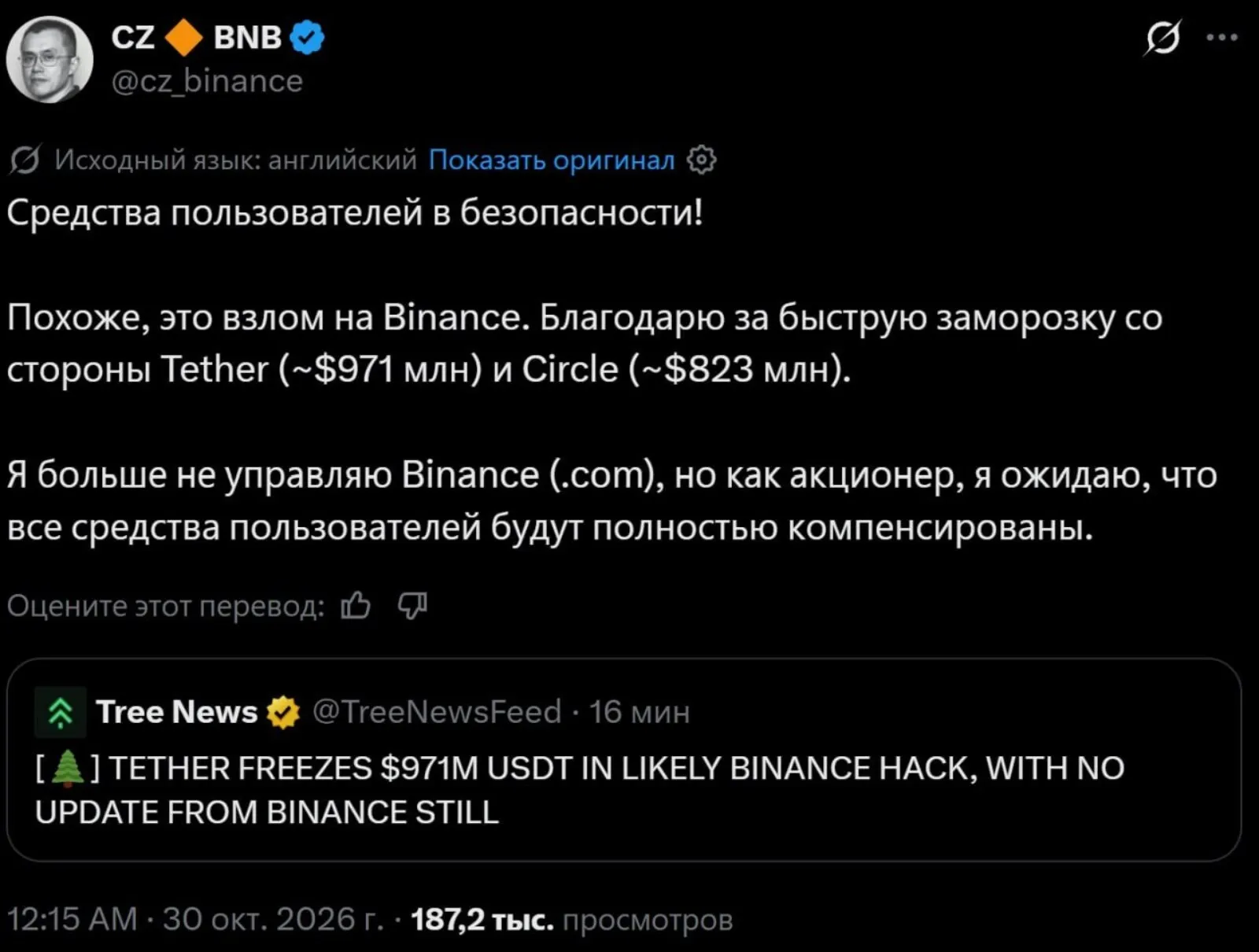
Later, Binance founder Changpeng Zhao, known as CZ, commented on the situation.
According to him, what is happening does indeed look like a hack. However, he emphasized that he no longer manages Binance's operations and remains a shareholder of the company.
Zhao thanked stablecoin issuers Tether and Circle for their rapid freezing of assets.
According to his data, Tether froze about $971 million in USDT, and Circle froze approximately $823 million in USDC.
The total amount of frozen assets approached $1.8 billion.
The Binance founder also expressed confidence that user funds would be protected.
The exchange itself reported investigating suspicious activity and assured users that their funds are safe.
However, the final technical cause of the incident, the exact amount of permanent losses, and the scale of the potential infrastructure compromise had not been established at the time of this report.
How Tether and Circle were able to stop billions of dollars
Major stablecoins like USDT and USDC are managed by centralized issuers.
Unlike standard ETH or BTC, their smart contracts allow for certain addresses to be blocked.
It was this exact mechanism that allowed for the rapid freezing of a significant portion of the assets linked to the suspicious Binance transfers.
But such protection has its limits.
If attackers managed to swap stablecoins for ETH or other assets that do not support centralized freezing, regaining control over the funds becomes significantly harder.
Furthermore, freezing does not mean an automatic return of funds to the owners. This may require additional legal and technical procedures.
Polymarket: attack via third-party JavaScript
On the same day, another incident occurred affecting the prediction market platform Polymarket.
Users began reporting unauthorized transactions and funds disappearing from their accounts.
The platform temporarily restricted trading, allowing existing orders to be canceled but blocking the creation of new trades.
Operations via the relayer—the infrastructure that transmits signed transactions to the blockchain—were also suspended.
Polymarket later confirmed that the cause was the compromise of a third-party software provider.
According to Reuters and other outlets, the provider in question is DebugBear, a British company that provides website performance monitoring tools.
Its software code was embedded in the Polymarket web interface.
Following the compromise of this component, attackers gained the ability to manipulate user actions within the trading platform.
How a third-party script could steal cryptocurrency
According to preliminary analysis by Hudson Rock researchers, the malicious code exploited active user sessions.
It could obtain information about open positions, initiate their sale, and direct the resulting assets to attacker addresses.
The particular danger was that these actions were performed within the context of an already authenticated user.
Thus, attackers did not necessarily need to steal a wallet's seed phrase or hack smart contracts.
It was enough to compromise an external component that the website trusted.
This is a classic software supply chain attack, where attackers target a technological contractor rather than the primary system itself.
How much money Polymarket users lost
According to preliminary estimates from blockchain analysts, attackers withdrew approximately $2.6–2.7 million.
The company Bubblemaps reported that the attack may have affected roughly 700 users.
Individual traders reported significantly larger personal losses. One user reported the disappearance of $800,000.
These claims require cautious interpretation, as the exact number of victims and the final amount of damage have not yet been determined.
Polymarket stated that it identified and resolved the issue, after which trading was resumed.
The company also promised to fully compensate all affected users.
Information regarding the incident has been passed to British law enforcement.
What do these events mean for the market?
The Binance and Polymarket incidents demonstrate two different levels of threat.
In the first case, we are looking at the potential compromise of a major centralized exchange's infrastructure and the movement of billions of dollars.
In the second, an attack via a third-party software component embedded in a web interface has been confirmed.
Both cases demonstrate how heavily the security of digital assets depends on infrastructure that remains invisible to the average user.
Behind the familiar interface lie external libraries, cloud services, wallets, transaction signing mechanisms, and permission management systems.
The compromise of any of these components can lead to financial losses.
For users, this means the need to be more cautious when connecting wallets, responding to new transaction signing requests, and using third-party integrations.
If you are interested in AI, technology, and the future—welcome to my channel to discuss and share updates.
Translated from Russian. Original on vc.ru: За один вечер под удар попали Binance и Polymarket. Из криптобиржи вывели миллиарды, а пользователей атаковали через код стороннего сервиса.