It's all dead: the software development lifecycle is no more, thanks to AI agents
AI agents have transformed the development process, eliminating stages, accelerating code generation, automating testing and deployment, and redefining the developer's role.

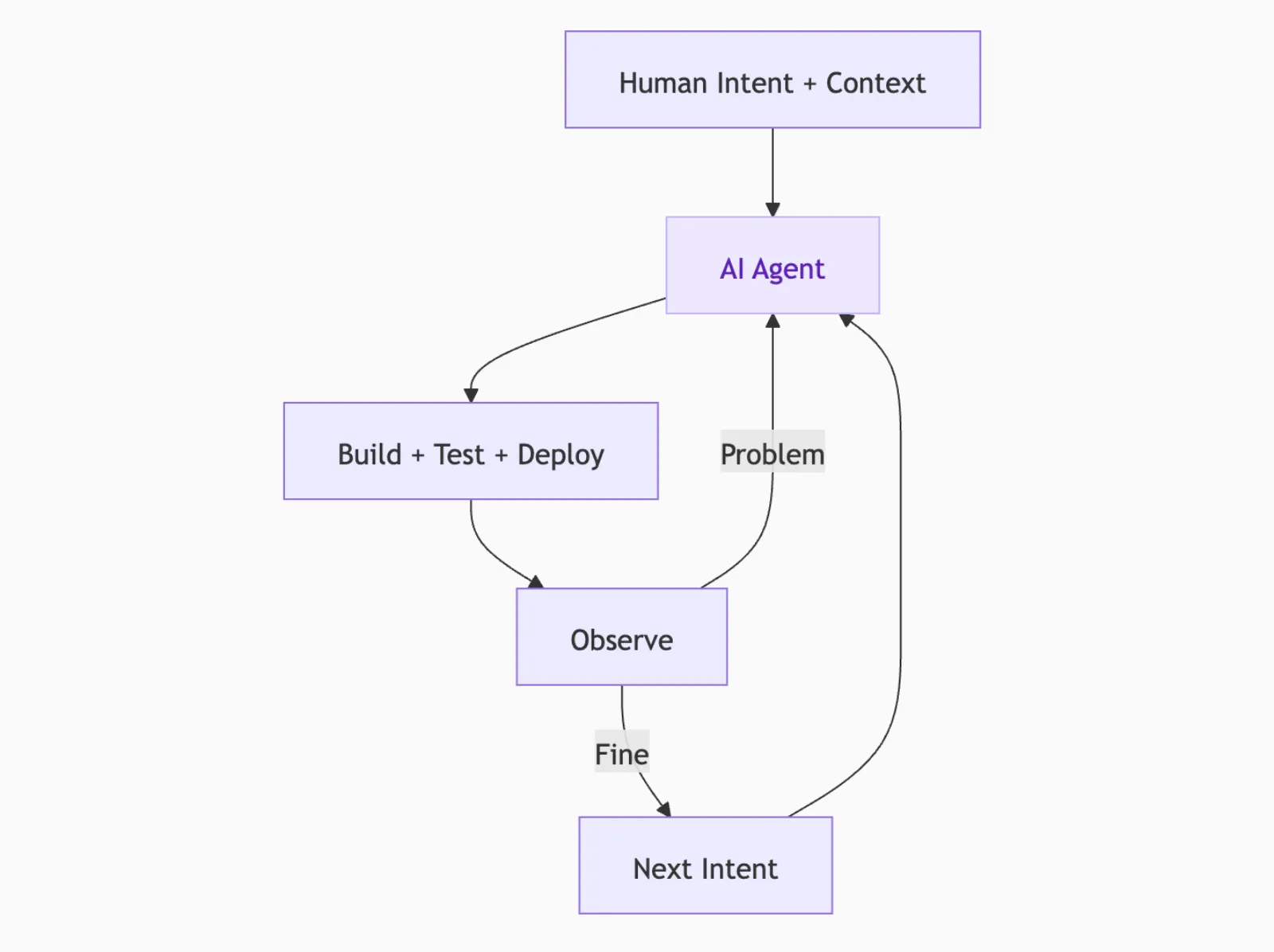
AI agents haven't just made developers "ten times faster." They have destroyed the very development model that the industry has been built upon for the last 30 years. The classic software development lifecycle looked familiar: requirements gathering, system design, coding, testing, code review, deployment, and monitoring.
Now, everything is compressing into a single cycle:
намерение → агент → результат → наблюдение → следующая итерацияNo tickets, no sprints, no task estimation, and no review queues.
Development stages no longer exist
When a developer works with an AI agent, the process looks entirely different. The developer describes the task. The agent generates the code, tests, and infrastructure. The human reviews the result, refines the task, and triggers the next iteration.
Everything happens simultaneously. There is no separate requirements phase. No lengthy design period. No weeks of implementation. No code review queue. No separate testing phase.
Instead of a long process, what remains is a short loop: intent, result, iteration.
Requirements, architecture, and code are merging
Previously, requirements had to be finalized in advance because development took weeks or months. Now, an agent can assemble a working version of a feature in minutes.
As a result, requirements are ceasing to be documents and are becoming mere directions. The developer provides the context, receives several solution variants, and picks the best one.
The same is happening with architecture. It is increasingly emerging directly during the interaction with the agent.
Agents are writing the code
AI agents are already capable of generating complete solutions: code, error handling, tests, and infrastructure. Developers are manually typing code less and less. Their role is shifting toward task definition, result verification, and context management.
Code review is becoming a ritual of the past
The classic code review process is starting to look absurd. An agent can generate hundreds of changes per day, while a team is physically capable of reviewing only a few dozen.
Therefore, manual review is gradually being replaced by automated tests, static analysis, and systems where one agent verifies the work of another.
A human steps in only when the system truly cannot make a decision on its own.
Deployment is becoming automatic
Code can automatically pass checks, build, and reach the production environment almost immediately after generation.
Features are rolled out gradually, using canary releases and automated rollbacks in case of errors.
All of this happens without human intervention.
The only thing left is monitoring
If code appears faster than a human can verify it, system observability becomes the primary safety mechanism.
But even here, the model is changing. Monitoring is increasingly used not for humans, but for agents. The system detects a problem, the agent analyzes it, and attempts to fix it automatically.
What remains for the developer
The primary skill is no longer managing development processes. The primary skill is managing context.
The more accurately a developer describes the task, the system constraints, and the business logic, the better the result will be.
The software development lifecycle as we know it is dead. And while part of the industry continues to build processes from a previous generation, a new model is already beginning to take shape.
Translated from Russian. Original on vc.ru: Всё умерло: жизненный цикл разработки больше не существует из-за AI агентов


