Mini-frameworks for managers. How to cut through the chaos and make decisions faster? Bezos's two types of decisions, the Covey matrix.
Mini-frameworks for managers, decision making, Covey matrix, Bezos's types of decisions, team management, effective conflict resolution


Most management problems are repetitive. A new team, resistance to change, someone not up to the role, a conflict over a decision. The situations vary, but the patterns are the same.
When you have simple management frameworks, you:
- make decisions faster
- explain your decisions to the team in plain language
- burn out less because you rely on a system rather than intuition
Below are several mini-frameworks you can start applying as early as tomorrow.
1. Three stages of solving a management task
This is useful when you're facing something large and murky. For example:
- you are taking over a new team
- someone is consistently missing their targets
- you feel the department is performing below its potential, but you don't understand why
Instead of panicking and "doing something just to do something," work through these three steps.
Step 1. Collection
First, you simply absorb information.
- read documentation, old plans, performance reviews, correspondence
- conduct 1-on-1 meetings
- ask clarifying questions
- listen a lot and take notes
A signal that you've collected enough: information starts to repeat, and there are almost no new facts.
Example: Five different people have told you roughly the same thing about employee X. The same observations keep surfacing in meetings, and new details are rarely added. This means it's time to move to the next step rather than digging indefinitely.
Step 2. Connecting the dots
At this stage, you stop collecting data and start thinking.
- review your notes
- sketch out hypotheses
- draw diagrams
- give yourself time to just walk, think, and talk through it out loud
The goal here isn't to "guess the truth," but to create an explanation that is:
- evidence-based
- logical
- actionable
For example, you formulate a hypothesis: the person isn't failing due to lack of talent, but rather due to a conflict of expectations regarding their role and priorities. Or vice versa: the role is objectively above their current level.
Step 3. Action
Next, you turn the hypothesis into a plan.
- change how tasks are assigned
- set specific expectations for results and deadlines
- agree on new processes (1-on-1s, checkpoints, mentorship)
Important: every action is simultaneously a decision and a test. If reality confirms the hypothesis, scale it. If not, go back to step one and refine the picture.
2. How to make decisions with a team: three models
Not every decision needs to be "democratized." But a "because I'm the boss and you all agree" approach rarely works either.
There are three basic models.
The Independent Model
The manager makes the decision alone and presents the finished version to the team.
Pros
- minimum time spent
- fast in a crisis
Cons
- low engagement
- easy to trigger passive resistance
Best for technical and procedural decisions where speed matters more than consensus.
The "Draft" Model
The manager prepares a first version and is honest: "This is a working version; let's review and improve it."
Pros
- saves time
- creates a sense of involvement
- people see that their opinions are being considered
Cons
- requires discipline: you must be truly prepared to change your position
A good format for team policies, processes, and interaction models with other departments.
The Collaborative Model
The decision is born from scratch with the team. You moderate the discussion, but you don't provide a starting version.
Pros
- the strongest sense of ownership
- the team defends the decision because it is "theirs"
Cons
- slow
- easy to slip into endless discussions
Best for key matters: long-term product strategy, core values, major structural changes.
It is important to choose your model intentionally in advance. And do not be afraid to change it if you see you've gone down the wrong path.
3. Bezos's Two Types of Decisions
In a letter to shareholders back in the nineties, Jeff Bezos divided decisions into two types. It's a simple idea that saves a lot of nerves.
Type 1
A decision that is difficult to reverse.
For example:
- choosing the tech stack for a core product
- moving headquarters
- changing the business model
These decisions should be approached slowly, with consultation, and with time allocated for doubts and questions.
Type 2
A decision that is easy to reverse.
For example:
- writing a headline for a landing page
- the order of blocks in a presentation
- the formatting of an internal report
These should be made quickly, in small groups, and without fear of changing them when new data appears.
The biggest mistake managers make is treating Type 2 decisions as Type 1. As a result:
- everything slows down
- the team stops experimenting
- the product ages faster than the market changes
A useful question to ask yourself: "If this choice turns out to be a mistake, how expensive will it be to roll it back in a month?"
4. How to resolve disputes and "break ties"
As a leader, you are responsible for the result, not for the comfort of everyone involved in a dispute. Sometimes you need to say: "This is how we are doing it."
There are three honest formats.
Format 1. The argument wins: "We'll do it your way because you presented logic and data that are objectively stronger."
Format 2. The context wins: "We'll do it my way. I have data and constraints that you can't see right now. I will explain why this is the decision."
Format 3. Responsibility wins: "Objectively, we cannot prove whose version is better. It's a tie. Therefore, I am making the decision as the person responsible for the result. If it turns out to be a mistake, it is entirely my responsibility."
When you articulate this out loud, people feel less like "we aren't being heard" and more like they understand exactly how decisions are made in the team.
5. Stephen Covey's "Urgent-Important" Matrix for Tasks
A manager lives in a stream of requests. "Urgent fix," "urgent approval," "urgent report." It is very easy to spend your entire day in "firefighting" mode and make zero progress on important topics.
The classic Covey matrix helps you quickly categorize tasks:
- urgent and important
- important but not urgent
- not important but urgent
- not important and not urgent
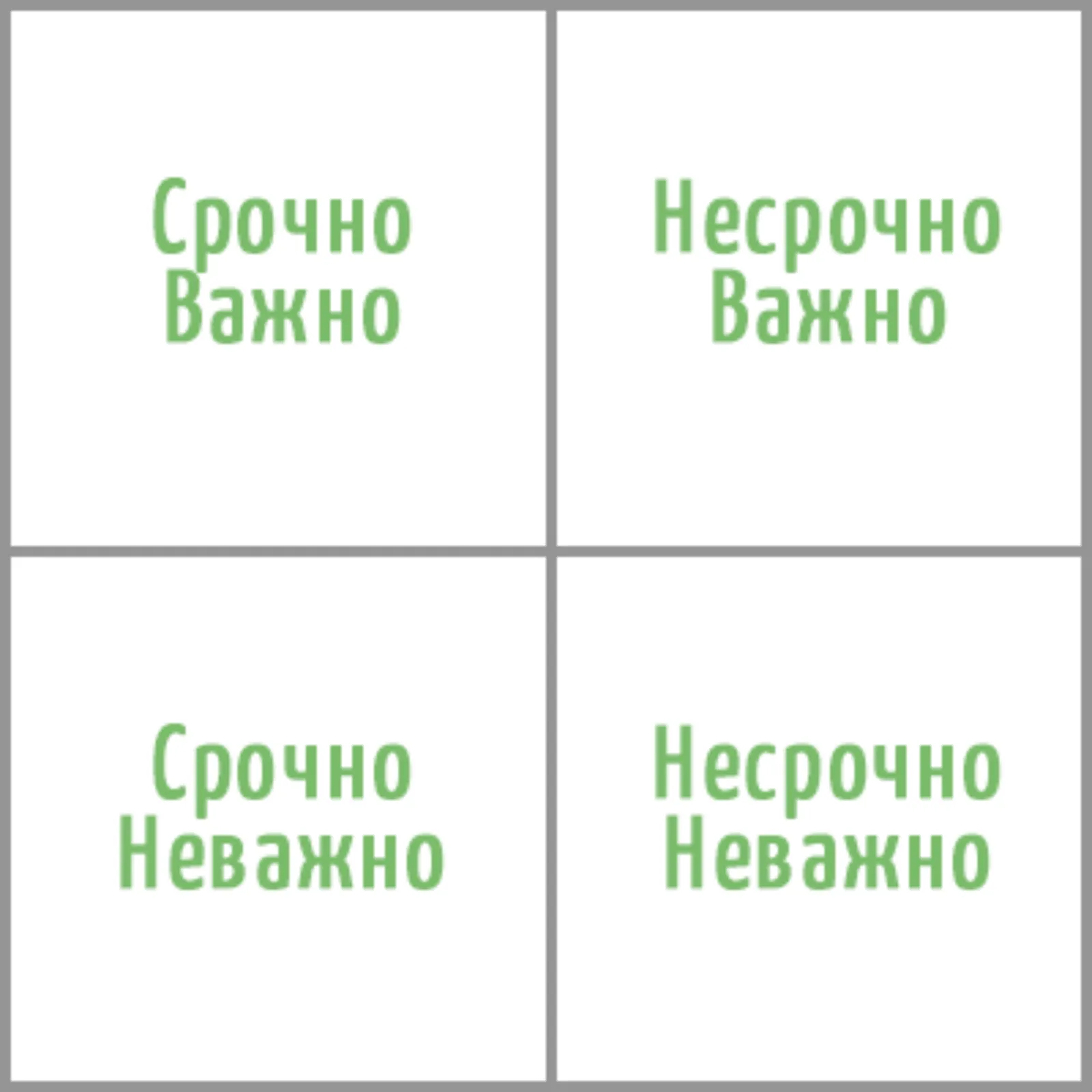
A simple exercise:
- List all your tasks for today or the week
- Assign two attributes to each: does this affect key goals? Is there a hard deadline?
- Decide in advance how much time you are willing to spend on each category
More often than not, a manager fails in the second quadrant, "important but not urgent"—which is exactly where strategy, people development, and systemic improvements reside.
6. The Manager as a "Human Puzzle" Assembler
Most of your work as a leader is actually not about tasks, but about people.
- how to get two strong but conflicting specialists to work together
- how to honestly tell someone they aren't performing without crushing their motivation
- how to build a team where roles complement each other
Human reactions are rarely linear. What a person says and what they feel often do not align.
It is useful to think like a researcher:
- always collect data: observations, phrasing, reactions
- formulate a hypothesis: "if I do this, they will likely react like that"
- try a small action
- observe what happens
- update your hypothesis
This makes you:
- more attentive to people
- more composed regarding mistakes
- stronger in recurring situations when the same pattern emerges with different people
Translated from Russian. Original on vc.ru: Мини фреймворки для менеджеров. Как быстрее разруливать хаос и принимать решения? Два типа решений по Безосу, матрица Кови.