Opinion: Older generations hold almost all accumulated wealth, while Millennials and Gen Z are left with nothing.
Older generations hold the wealth; Millennials and Gen Z lack assets. Economic disparity, high inflation, and limited access to credit.

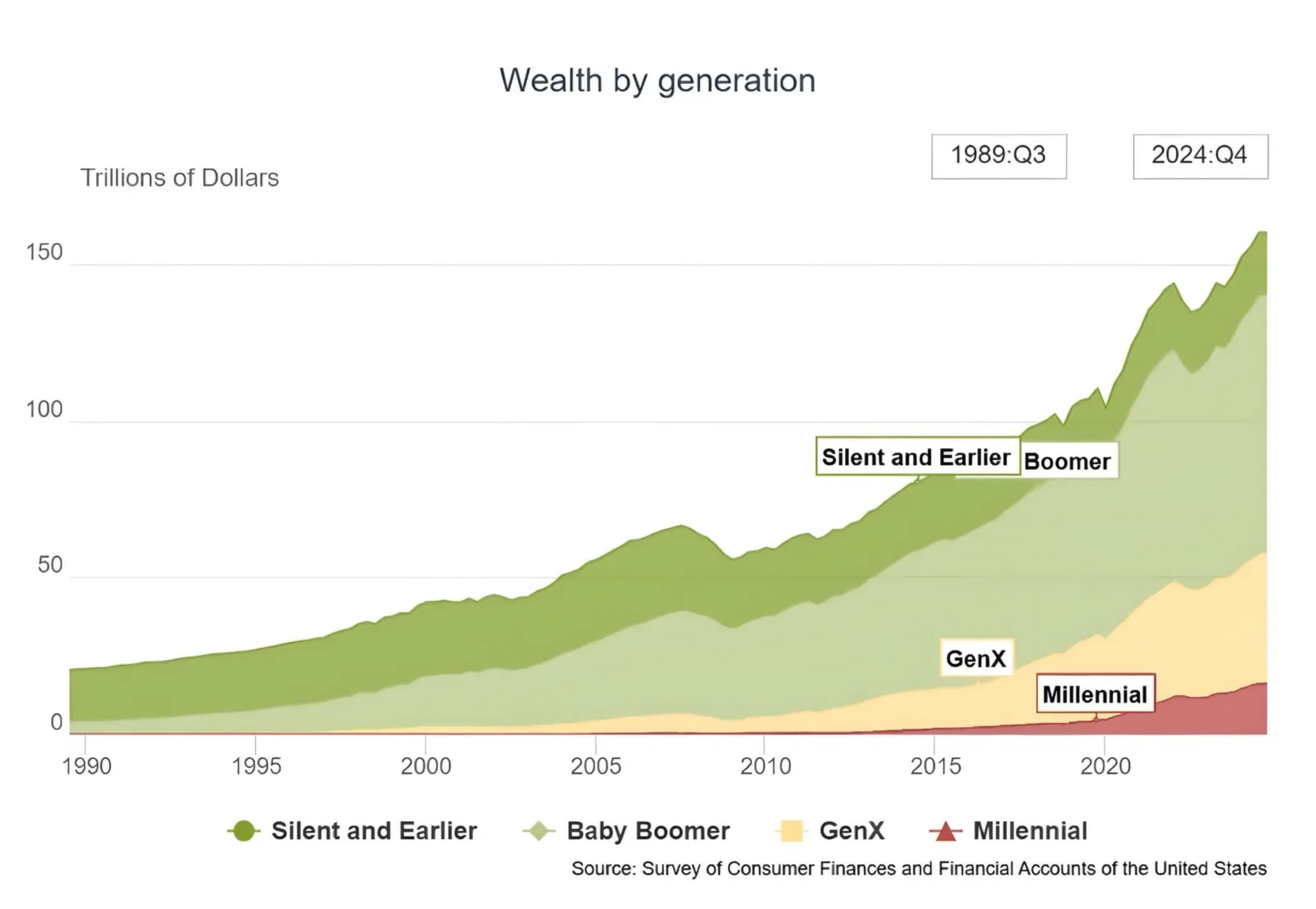
In recent months, social media has been buzzing with discussions about how Baby Boomers and older generations hold almost ALL accumulated wealth, while Millennials and Gen Z hold almost nothing.
Some have concluded from this that once older generations retire and sell off their assets, wealth will eventually "trickle down."
So, what is wrong with the economy, and what can the new generations actually expect?
Can wealth simply be handed over?
Most of the capital held by older generations isn't cash or suitcases full of money. It consists of real estate, stocks, pension funds, businesses, and debt instruments.
To sell an asset, you need a buyer with money. And who has that money?
Millennials and Gen Z don't have it in sufficient quantities. Incomes are growing slowly, real wages are being eaten away by inflation, the share of mandatory expenses is higher than in previous generations, and access to cheap credit is worsening.
If the number of sellers increases while there are no solvent buyers, prices drop. A mass sell-off of assets doesn't create wealth; it destroys it.
Will the younger generations "pick up the slack" in the market?
The assumption is that younger generations will step in as the new buyers. But to do that, they either need to get rich quickly or gain access to cheap money.
HOWEVER, interest rates are high, credit is expensive, and mortgages are out of reach for many. Governments are preoccupied with servicing their own debt rather than stimulating widespread prosperity.
As a result, a gap emerges: the assets exist, but there is no demand for them at desired prices.
Will the wealth transfer be equitable?
Even if a portion of capital is passed down through inheritance, it will be distributed extremely unevenly. Wealth doesn't "flow" between generations; it is transferred within families.
This means it won't be the Millennial generation as a whole that gets wealthier, but a narrow slice of people who are already in privileged positions.
For the economy as a whole, this isn't growth—it's an intensification of capital concentration.
So, what is actually happening?
We are witnessing not a transfer of wealth, but a structural crisis of the accumulation model. Older generations are used to living in a world of rising markets, cheap money, and expanding consumption. Younger generations live in a world of constraints, expensive resources, and high uncertainty.
The economy is looking less like a system of opportunity and more like a system of risk redistribution, where losses are socialized and profits are concentrated.
Where is all of this heading?
The likely scenario does not look optimistic:
- pressure on asset markets
- rising tax burdens
- further inflation as a hidden way to zero out obligations
- a widening gap between capital owners and those living paycheck to paycheck
This is a slide into a stagnant economy, where growth becomes the exception rather than the norm. It seems we shouldn't expect a "great wealth transfer." Do not rely on the legacy of an abstract generation. Instead, build your own income streams—mobile, adaptive, and not tied to a single asset or a single country.
The economy is heading into an era where the winners are not those who wait, but those who know how to pivot quickly.
What are your thoughts on this? Share your opinion—I'd love to hear it!
If you are interested in AI, technology, and the future, welcome to my channel to discuss and share updates.
Translated from Russian. Original on vc.ru: Мнение: Старшие поколения владеют почти всем накопленным богатством, а миллениалам и зуммерам ничего не светит.