Post Mortem: The Cloudflare outage took down half the internet again. What happened and how to avoid it?
The Cloudflare outage affected X, ChatGPT, Canva, and over 20% of the internet; the cause was single-vendor dependency, and here is how to prevent similar issues in the future.

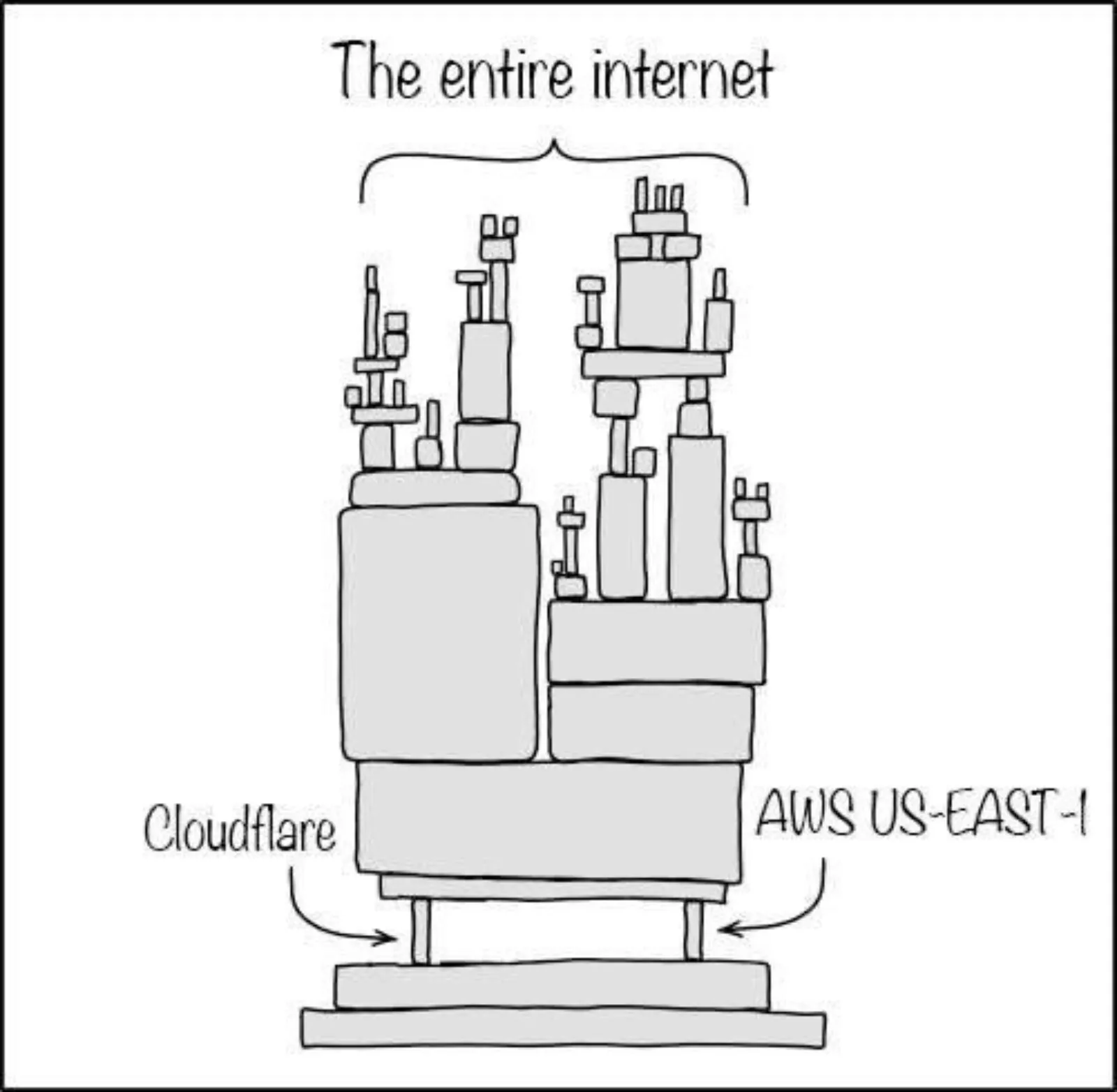
On the morning of November 18, 2025, around 6:40 AM, Cloudflare registered significant outages affecting major platforms: X (Twitter), ChatGPT, Canva, and many others.
According to official reports, Cloudflare stated that the primary issue has been resolved. However, residual disruptions or increased error rates may still be observed.
Cloudflare experienced a surge of unusual traffic, and their filtering subsystem collapsed following a configuration change. The issue was caused by an incorrect configuration file for the Bot Management protection system. Due to changes in access permissions within the ClickHouse database, the query generating this file began returning duplicate records.
The file size exceeded permissible limits, causing Cloudflare's core proxy engine to trigger massive errors. As a result, client services using bot filtering mistakenly blocked legitimate traffic.
Cloudflare outage on November 18, 2025blog.cloudflare.comCloudflare CTO Dane Knecht apologized to customers and users:
The error itself, its consequences, and the time taken to resolve it are unacceptable. We are working to ensure this does not happen again. I understand the problems we have caused. But our customers' trust is our primary value. And we will do everything possible to earn it back.Dane Knecht, CTO of Cloudflare
It wasn't a DDoS or an attack, but a combination of unusual traffic and a bug in their own processing logic. The bottleneck was located within a single critical component; the configuration grew larger than expected, services began to fail, and Cloudflare's network automatically propagated the error globally.
The main fact that no one wants to admit: the internet didn't go down, a single provider went down, and that was enough to paralyze a significant portion of global services.
This is the key takeaway.
Why were companies affected?
It wasn't because of Cloudflare. It was because companies tied their entire vital infrastructure to a single player. This is a lazy and cheap solution—convenient in the short term, catastrophic in the long run. When you have one CDN, one DNS, one WAF, and one edge layer, any internal failure on their part becomes your unmanaged dependency. Companies convinced themselves that a major provider essentially guarantees stability. This is a false sense of security. Large providers do fail; they just do so less frequently and on a larger scale.
How to avoid this in the future?
1. Multi-CDN
Not one provider, but two or three. An automatic failover. If one goes down, traffic shifts. It is more expensive and complex, but it survives outages.
Cloudflare + Fastly, or Cloudflare + Akamai, or Fastly + Bunny.
2. Independent DNS
Using DNS from a single player, especially the same CDN, is self-destruction. Two independent providers solve half of the availability problem.
NS1, Route 53, Google Cloud DNS, Akamai DNS
3. Minimizing logic in third-party environments
Many companies implement redirects, rules, filters, and even business logic within Cloudflare Workers. This convenience turns into dependency. The more logic you embed into a single platform, the more paralyzed you become when they fail.
4. Disaster Recovery Plan
Not just in documentation, but a real, tested mechanism. Most companies believe "we have everything under control" until the moment they can't even log into their admin panel.
5. Conscious risk assessment
Either calculate the cost of an hour of downtime, or live in the illusion that downtime won't happen. The illusion always ends the same way: expensively.
The problem isn't Cloudflare; the problem is that companies prioritized convenience over architectural resilience. They built their businesses on a single provider and were then surprised when that provider broke. If a business wants to survive the next global outage, it must move away from the single-provider mentality.
Translated from Russian. Original on vc.ru: Post Mortem: Сбой Cloudflare снова выключил половину интернета. Что случилось и как этого избежать?


