The Agency: 140+ AI agents that turn a chat with AI into a digital team
The Agency on GitHub: AI agents for development, design, marketing, sales, and testing—a systematic approach to working with AI and building a digital team

The Agency is a public open-source repository on GitHub that hosts a massive library of AI agents for a wide range of workflows. It covers everything from development and design to marketing, sales, testing, product management, spatial computing, game development, and even academic disciplines related to world-building, storytelling, and character psychology.
What exactly is The Agency?
The core idea of the project is that each agent here isn't just a short, one-paragraph prompt; instead, it's defined as a distinct role with a specific specialization, personality, task-oriented approach, workflow, and success criteria. In other words, we aren't just looking at a collection of ideas for interacting with a model, but an attempt to standardize AI behavior for specific professional scenarios.
The authors pitch The Agency as a 'dream team' composed entirely of AI specialists—specialists who don't sleep, don't get tired, don't complain, and are always ready to jump into a task, provided the user knows exactly which agent to activate.
How is the repository structured?
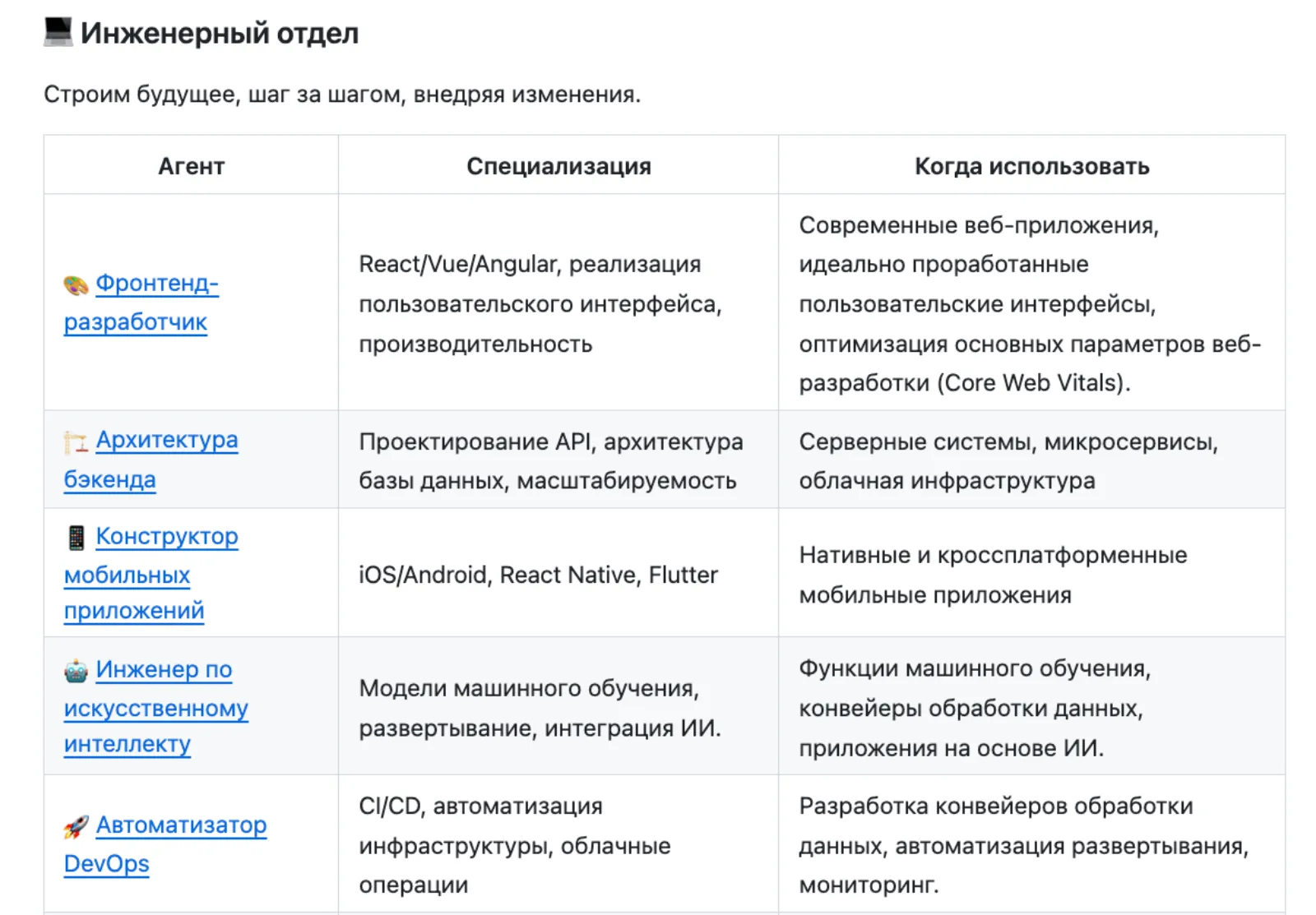
One reason The Agency is so captivating is its scale and structure. The repository is divided into large divisions, and within each division, there are roles for specific types of tasks. This makes the project feel less like a collection of random files and more like a map of a digital organization.
How does this differ from ordinary prompt libraries?
The main difference between The/Agency and typical prompt libraries is that what's being offered here isn't just a well-worded query, but the logic of the role itself. In a standard prompt library, a user usually gets one template for one scenario, which then has to be manually adapted, rewritten, and kept in mind. In The Agency, the focus is on a more systematic approach, where the agent already embodies the communication tone, the sequence of actions, the output format, and the standard for what constitutes high-quality work.
How do you use it in practice?
Users simply need to copy the agent files into the ~/.claude/agents/ directory. Once done, you can call these specific roles during your work sessions, interacting with Claude not as a universal model, but as a specific type of specialist—such as a frontend developer, backend architect, technical writer, or UX research expert.
But that's not all. The Agency was built with multi-tool compatibility in mind from the start. Therefore, the project supports not only Claude Code but also GitHub Copilot, Cursor, Aider, Windsurf, Gemini CLI, Antigravity, OpenCode, OpenClaw, and Qwen Code. To facilitate this, the repository includes conversion and installation scripts to help prepare the necessary file formats for each specific environment.
Why has this project gained so much traction?
The growing interest in The Agency is well-explained by the current shift in the market. Not long ago, users were mostly discussing which model was stronger—Claude, ChatGPT, Gemini, or Copint—and debating the general quality of responses. But now, the very framework of the discussion is gradually changing. Instead of asking 'which model is better,' the question is increasingly becoming 'how can we organize work with a model so that it functions more like a real team rather than just a single universal assistant.'
Which scenarios best illustrate this idea?
For example, to launch a startup MVP, the project suggests a lineup consisting of a Frontend Developer, Backend Architect, Growth Hacker, Rapid Prototyper, and Reality Checker. The emphasis here is not just on building the product, but on iteration speed, growth strategy, and quality control before launch.
For a marketing campaign, a completely different set is assembled: Content Creator, Twitter Engager, Instagram Curator, Reddit Community Builder, and Analytics Reporter. Here, you can see that the authors are thinking in terms of platform-native execution, where each platform requires its own approach and analytics are inseparable from creativity.
But there are limitations
Despite how appealing the idea is, it's important not to overhype projects like this. First, a large number of agents does not necessarily mean each one is equally useful in real-world work. In any collection like this, it is almost inevitable that some roles will sound impressive but, in practice, differ from each other less than the descriptions suggest.
Second, an agent without context is just a template. To actually deliver value, it almost always needs to be adapted to your specific tech stack, team culture, product type, documentation requirements, and process maturity. Without this, even a well-described role risks remaining nothing more than a beautifully formatted Markdown file.
Third, the more agents you have in a system, the more critical the issue of orchestration becomes. It is one thing to have a library of roles, but quite another to learn how to effectively pass tasks between them, maintain context, avoid duplication, and ensure the integrity of the final result. The next logical step for projects like this isn't just adding new specialists, but building the mechanics of coordination between them.
Finally, there is a fundamental limit to any agentic system: behind every beautiful role, there is still the same underlying model or group of models. This means that specialization is achieved not through the magical emergence of new intelligence, but through the proper definition of boundaries, tone, structure, and operational rules. This is useful, but it shouldn't be mistaken for a truly independent team in the human sense.
Link to the repository in the comments.
Translated from Russian. Original on vc.ru: The Agency, 140+ AI-агентов, которые превращают чат с ИИ в цифровую команду


