Why the AI boom can't last forever? Anthropic's revenue deception and the real AI economy revealed.
Anthropic's $5 billion revenue, court documents, AI expenses exceeding income, subsidized subscriptions, rising AI service prices.

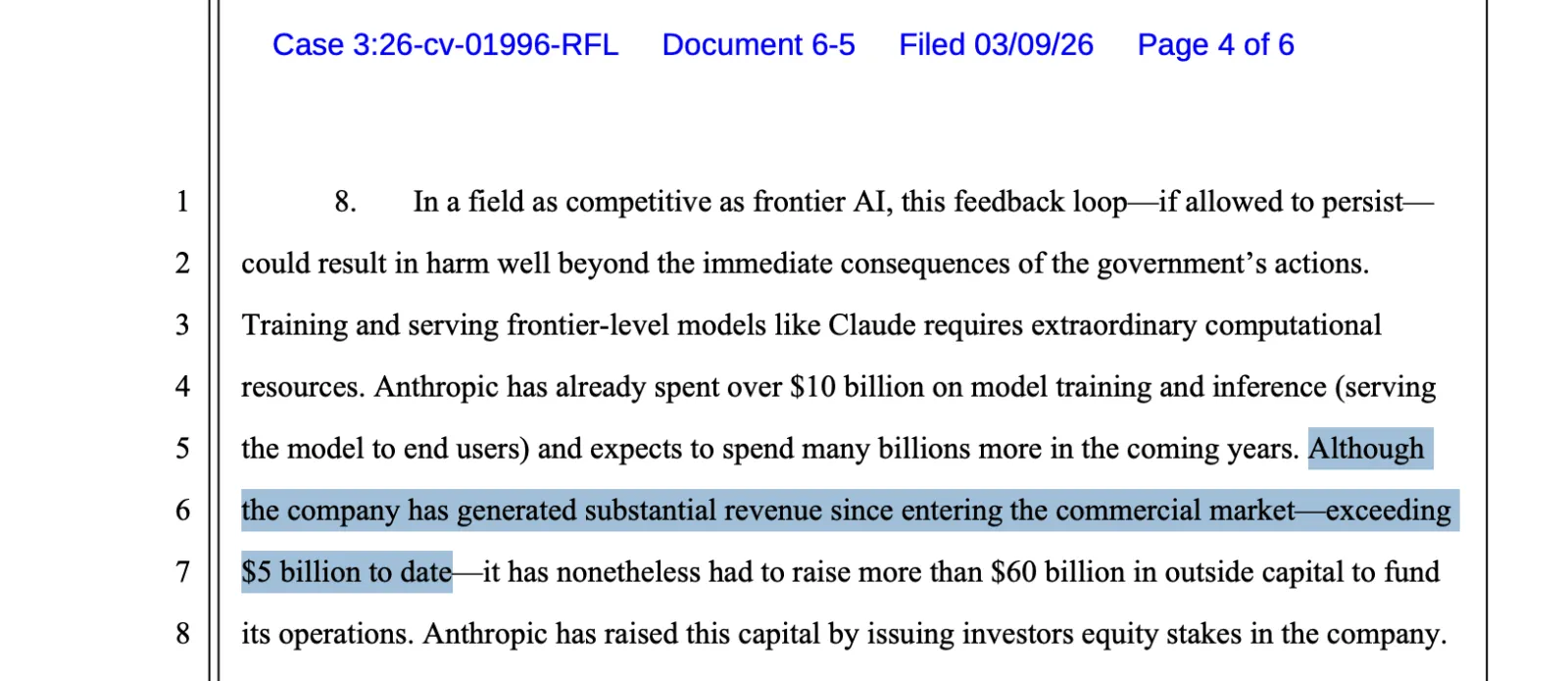
TLDR: Media outlets are spreading stories of $14–19 billion in annual revenue for Anthropic, but court documents reveal $5 billion in revenue over the company's entire existence. At the same time, it turns out that every subscription may consume computing power worth many times its actual price.
What do the real Anthropic figures show?
In a lawsuit filed by the company against the US Department of Defense, case materials revealed financial data, including a statement from the CFO, stating that the company's total commercial revenue over its entire lifetime amounted to approximately 5 billion dollars. Crucially, this refers to revenue, not profit, while total expenses for training models and their operation—namely, user inference—have already exceeded 10 billion dollars. The company also explicitly states that it expects to spend many billions more on infrastructure development and support in the coming years.
Where, then, do the $14–19 billion figures come from?
Despite these facts, media reports actively circulate figures claiming the company's annual revenue has allegedly reached 14 billion dollars, with some publications even increasing this estimate to 19 billion. However, these values do not refer to actual revenue, but to the so-called run rate, which is a hypothetical annual revenue estimate obtained by extrapolating current or recent performance over the next 12 months.
The problem is that in public communications, such metrics are often perceived as real money the company has already earned. In practice, however, a run rate is usually calculated based on a short-term period—sometimes even the most successful month—and then simply multiplied by twelve. In some cases, an even more optimistic methodology is used, where subscription revenue is recalculated into an annual format separately, while transactional revenue from API usage or tokens might be recalculated based on a roughly four-week period and then scaled to thirteen similar periods in a year.
As a result, an estimate is formed that may look impressive and truly reflect the company's growth rate, but simultaneously differs significantly from the cumulative revenue earned throughout its time on the market, which, according to Anthropic's court documents, is approximately five billion dollars.
Subsidized subscriptions and the real cost of computing
An even more interesting detail in this data relates to internal estimates of user maintenance costs, as it turns out that some commercial products may consume computing resources worth many times the cost of the subscription itself. One example involves the Claude Code programming tool, where the subscription cost is around 200 dollars per month.
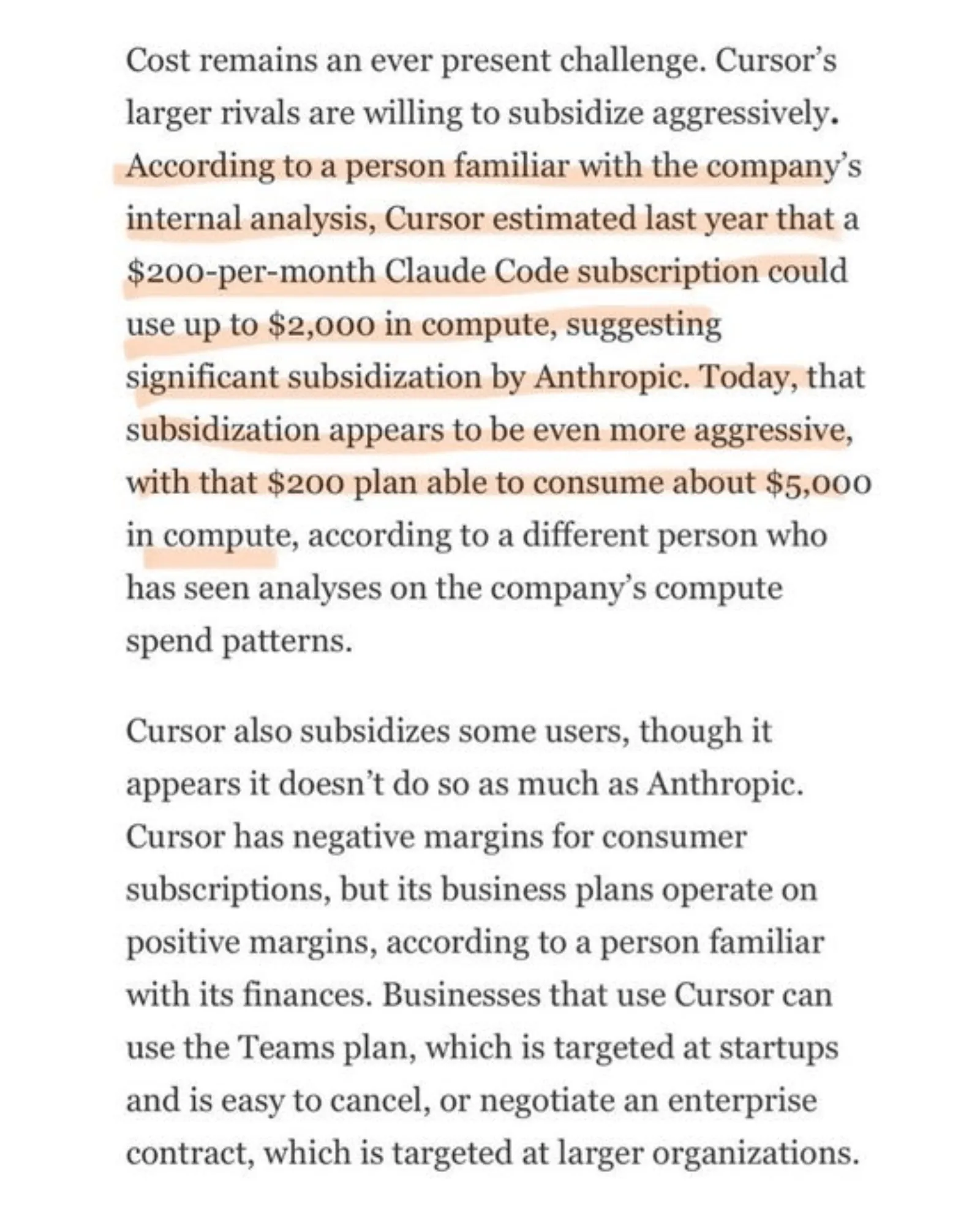
According to internal estimates cited in computing resource usage analyses, last year one such user could consume approximately 2,000 dollars worth of computing per month. Today, according to sources familiar with infrastructure usage patterns, the real computing cost for an active user could reach approximately 5,000 dollars per month, meaning that a significant portion of usage is effectively subsidized by the company.
This means that the user pays only a small fraction of the actual infrastructure cost, while the rest is covered by investment capital, corporate contracts, or expectations of future market growth. It is precisely this model that allows for relatively cheap access today to extremely expensive computing systems running on thousands of GPUs in massive data centers.
Why isn't the AI economy balancing out yet?
The reason for this imbalance lies in a fundamental characteristic of modern AI models: training and maintaining so-called frontier models requires colossal computing resources, ranging from billions of dollars spent on training a single generation of a model to the constant expenses of inference, where every user request requires expensive GPU operation, energy consumption, network infrastructure, and memory.
The paradox is that the cheaper model usage becomes for the end user, the faster the total number of requests grows. Developers begin building automations, agents start working 24/7, programmers generate code significantly more often, and companies integrate models into more business processes, causing the load on infrastructure to grow faster than subscription revenues.
Why is the market tolerating this for now?
Nevertheless, the market continues to fund this model because investors are betting on long-term market capture. They assume that artificial intelligence will become the fundamental infrastructure of the digital economy, meaning that the companies that are the first to create the largest and most powerful models will be able to monetize them in the future through corporate contracts, platform ecosystems, and business process integrations.
This strategy has been used in other tech sectors, where companies worked with minimal or negative margins for many years to achieve rapid scaling and market dominance. However, in the case of artificial intelligence, the situation is more complex because the cost of infrastructure is much higher than that of classic internet services; we are not just talking about software, but about giant computing clusters, energy consumption, and the constant need to upgrade hardware.
Why could this end in price increases?
If the current subsidy model begins to shrink, the industry may face the need to sharply increase model usage prices, because the real cost of computing is significantly higher than the price users pay today. In such a case, the market could shift from the current regime of almost unlimited usage to a stricter pay-per-compute-resource model.
This means that in the future, the cost of intensive AI usage could increase several times over, and in some scenarios, even by an order of magnitude or more—especially for complex tasks like code generation, autonomous agents, or large-scale text and data processing, as these scenarios create the maximum load on the infrastructure.
Why might the current period prove to be temporary?
The end result is a situation where the AI market is undergoing a period of rapid growth, fueled by massive investments and aggressive user subsidies; however, actual company data, such as Anthropic's financial performance, shows that the industry's underlying economics have yet to achieve a sustainable balance between revenue and expenses.
Translated from Russian. Original on vc.ru: Почему праздник ИИ не может длиться вечно? Раскрыт обман Antropic о выручке и реальной экономике ИИ.


