Why the obsession with AI agents often turns out to be a waste of time (and especially money)?
AI agents are not magic, businesses are losing money, $41,000 per minute on useless computations, Claude Code and OpenAI Agents SDK, routine tasks and efficiency

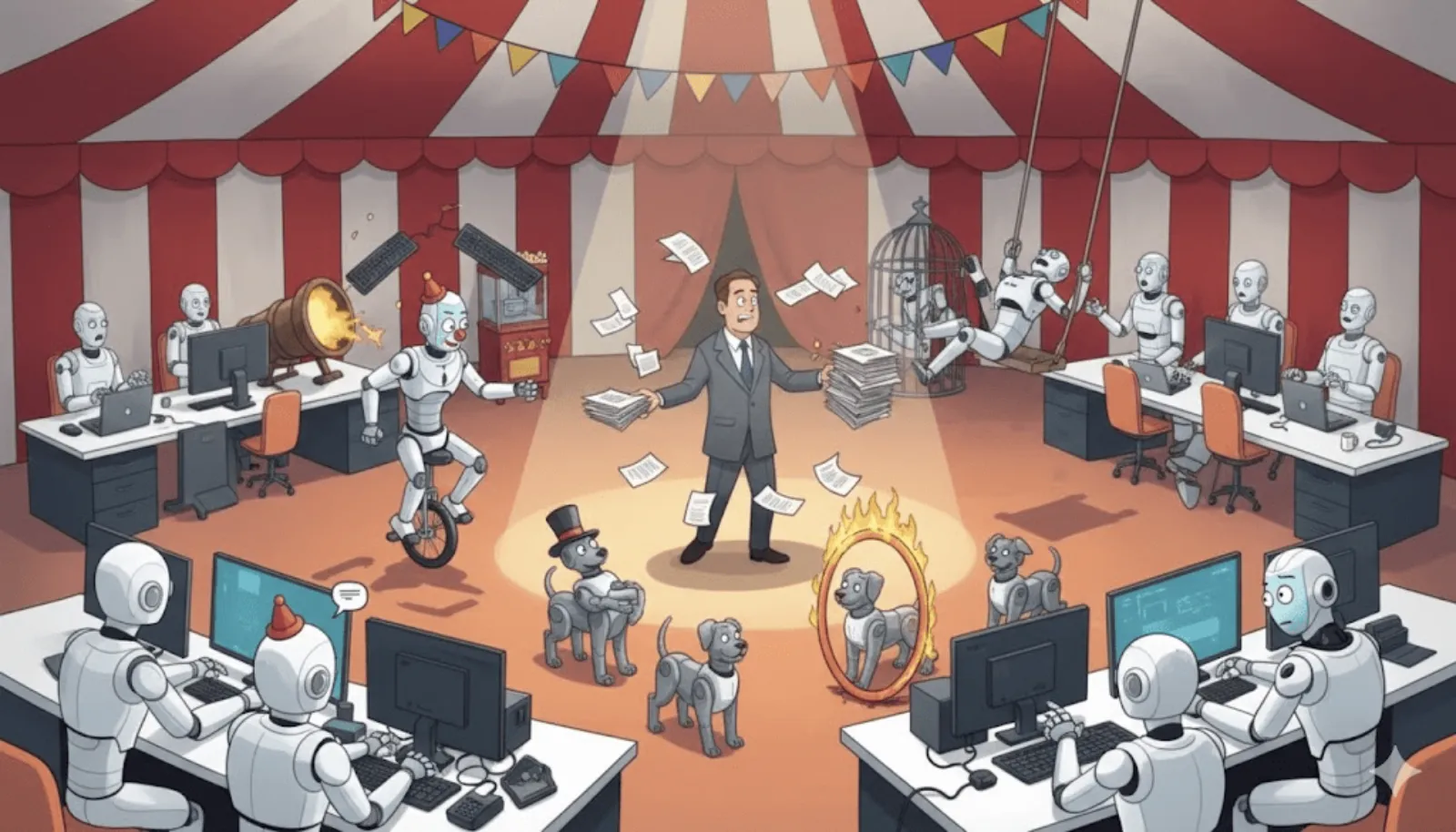
The idea of AI agents has become something of a new blockchain for the AI community. Almost every second project claims to offer autonomous, smart, multi-tasking digital employees. Developers are afraid of falling behind, and businesses are struggling to understand if this is even necessary, or if we are simply burning through budgets for the sake of a trendy term...
If you strip away the hype, an AI agent is not magic and not an independent mind. It is an architectural pattern. It is a way to force a model to do more than just generate text, but to act within a process: planning steps, using tools, verifying results, and, ideally, correcting its own mistakes. Essentially, it is an attempt to turn a probabilistic language model into a manageable business process.
The illusion of deception, the illusion of intelligence
An agent often seems smart only because it takes many steps. But the number of steps does not equal the quality of reasoning. By 202 better, the industry has finally admitted the problem of error accumulation out loud. Fundamentally, the model does not build a world model or understand cause-and-effect relationships. An agent remains a superstructure on top of a probabilistic generator. If a task lacks a rigid structure, the agent begins to wander in circles, beautifully and confidently.
This is exactly where RAG pipelines and reasoning chains hit an economic wall. Every extra action an agent takes results in additional tokens, latency, and the risk of hallucinations. Agents looping for hours are burning thousands of dollars right now.
In many production scenarios, a complex agent turns out to be worse and more expensive than a single well-designed prompt or a simple deterministic pipeline.
The world is already spending $41,000 per minute on useless agent computations
Let's calculate how much money is being burned in data center furnaces right now on stupid agent actions. This calculation is based on an extrapolation of the 2026 market at $180 billion, assuming an agent share of traffic of 30%, and a 40% loss coefficient due to loops, excessive context, and planning errors.
As a result, right now, every minute, approximately $41,000 per minute is being spent worldwide on useless agent computations.
If you optimize your agent and reduce the number of steps, or implement prompt caching, you aren't just speeding up the work—you are directly fighting this figure.
2026 Toolkit: sober engineering
This does not mean that agents have turned out to be a dead end. On the contrary, by 2026, they have found their true place. They are needed where there is an environment, system state, and verifiable feedback. Not in creative dialogues or philosophical discussions, but in routine tasks: log analysis, data orchestration, infrastructure monitoring, and managing internal processes.
Claude Code became the big hit of the year. It is a CLI agent that works directly in the terminal, which doesn't just write code, but navigates the repository, edits files, runs tests, and fixes bugs on its own.
Claude Agent SDK is a native package for Python and TS that simplifies the creation of thought-action loops specifically for Claude models, optimizing them for long contexts.
OpenAI Agents SDK effectively became the baseline in 2026 for those building agentic systems for production.
LangGraph became the standard not because it makes agents smarter, but because it provides control. While early chains were linear, now graphs with loops and checks are used: execute a step, check the result, and if there is an error, roll back and retry.
CrewAI, which was previously advertised as a way to create agent teams, also found its place, but with an important caveat. In 2026, it is used only within strict boundaries. Practice has shown that if you let agents communicate freely, they spend minutes and money on pleasantries rather than solving the task.
Is it worth studying agents now?
For a developer, the answer is mostly yes, but not as magic, rather as a design pattern. Understanding agentic architectures helps distinguish real engineering necessity from hype.
For a product manager or founder, also yes, but without fanaticism.
A designer, analyst, or strategist doesn't need to know how to write agentic code. But it is important to understand the mechanics—where an agent truly creates value and where it merely simulates activity.
AI agents make sense not when they are possible, but when doing things without them becomes more expensive, slower, or riskier
When the process is repetitive. If a task is of a single type, with similar steps and decision logic, an agent begins to pay off. One-off, creative, or intuitive tasks almost always win when handled by a human or a simple assistant.
When the process can be formalized. An agent needs a skeleton, rules, constraints, and success criteria. If you cannot explain what a good result looks like and by what criteria it is verified, an agent will only amplify the chaos.
When the cost of error is controllable. Agents work well where an error is not fatal or is easily rolled back.
When there is scale. If a task is performed by one person a couple of times a month, an agent is pointless.
When there is support infrastructure. An agent without monitoring, logs, cost control, and human oversight is garbage.
Not creativity, but a stable result. Agents are bad at finding new meanings, unexpected ideas, and aesthetic solutions.
P.S.
If an agent replaces routine, reduces workload, and makes economic sense, it has a place in production. If it just thinks expensively, its place is in a presentation, not in a product.
What do you think? Are you studying AI agents, or are you already building them every day—and for what purpose? Share your opinion!
If you are interested in the topics of AI, technology, and the future—welcome to my channel to discuss and share updates.
Translated from Russian. Original on vc.ru: Почему увлечение AI агентами чаще всего оказывается пустой тратой времени (и особенно денег)?