PhoneBot: How an old Android smartphone was turned into a bipedal robot for $400
UCLA's PhoneBot, a bipedal robot, uses Android for control and human recognition; an experimental platform for students and researchers

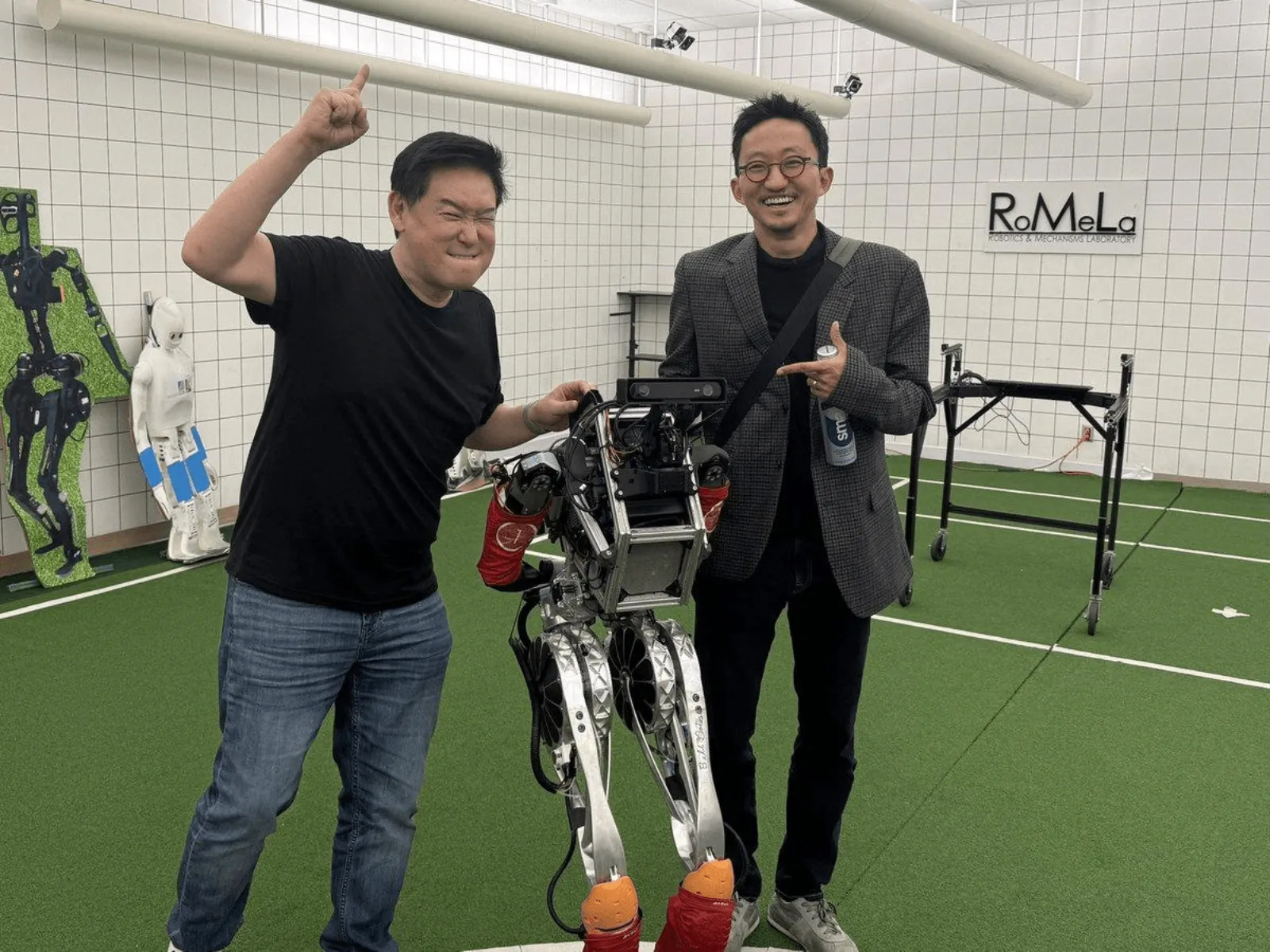
UCLA engineers have created a small robot that can walk, follow a person, and independently stand up after falling. Instead of a costly computer vision and computing system, it uses an ordinary 2017 Android smartphone.
On October 6, 2026, researchers from the Robotics and Mechanisms Laboratory (RoMeLa) at the University of California, Los Angeles, introduced PhoneBot. It is an open research platform that allows a low-cost smartphone to be transformed into the computing hub of a bipedal robot.
The project authors, Ruochen Hou, Quanyou Wang, Daniel Koh, and Dennis W. Hong, published a scientific paper titled PhoneBot: A Low Cost Open Humanoid Robot Platform Reusing Smartphones.
Their idea is simple: why develop a separate system of cameras, sensors, and powerful processors if almost everything necessary is already built into a phone?
A robot less than half a meter tall
PhoneBot features a compact design with two legs and a smartphone mounted vertically on the chassis.
The robot stands 48.3 cm tall and weighs approximately 1.8 kg. It uses 13 servomotors to control the leg joints and torso rotation.
Researchers estimate the hardware cost to be approximately $400, excluding the smartphone.
This is fundamentally different from the approach taken by manufacturers of full-sized humanoids, who create complex mechanical platforms with numerous sensors and specialized electronics.
PhoneBot is not trying to replace industrial robots. Its goal is to make experiments with bipedal walking more accessible to students, researchers, and small engineering teams.
How Android controls the robot's legs
The smartphone performs several functions at once.
Its camera allows for human recognition and direction tracking. The accelerometer and gyroscope track the body's position and help the control system maintain balance.
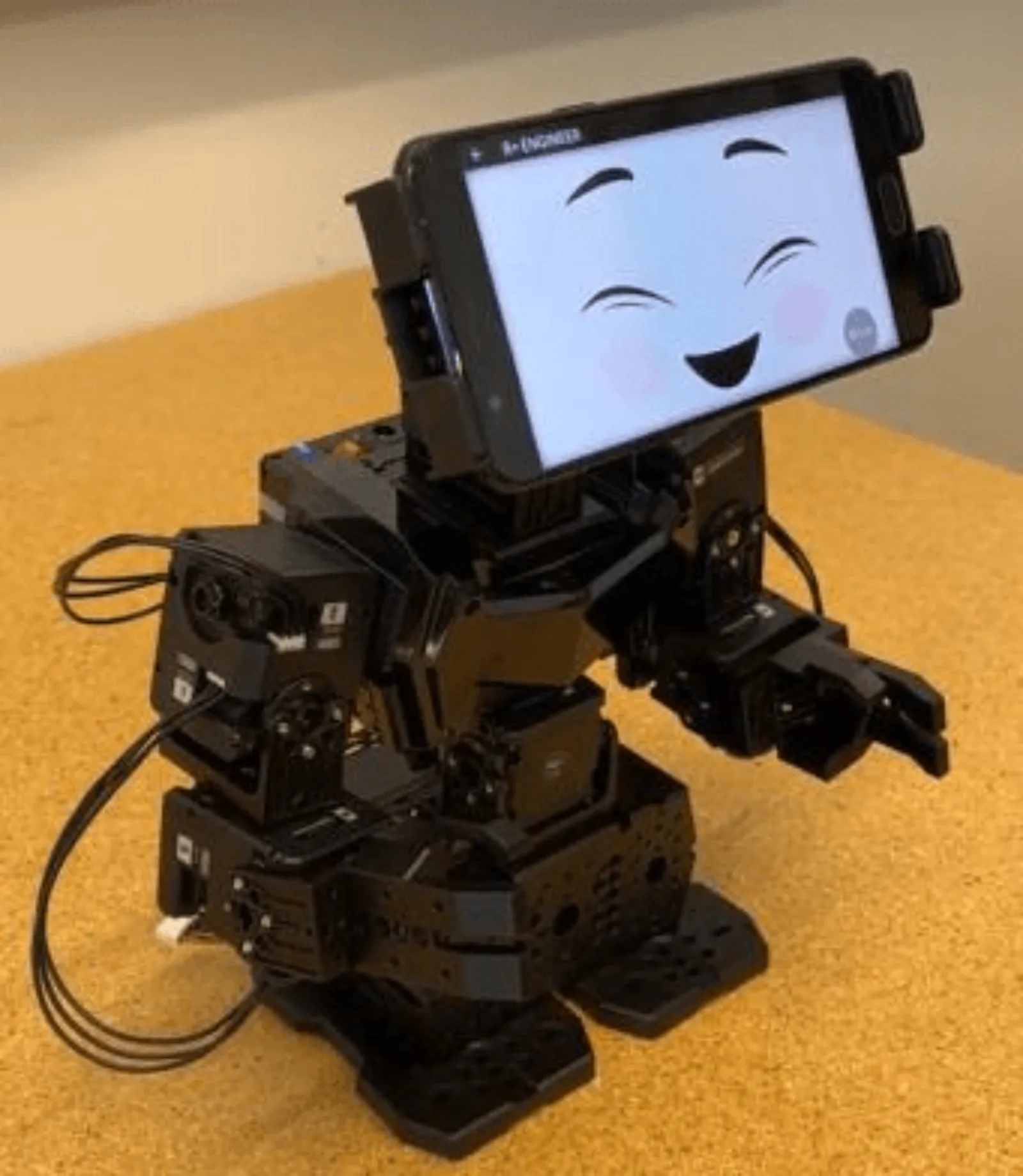
The processor runs computer vision algorithms and a neural network-based motion control model.
Commands are transmitted via WiFi to a separate built-in controller that manages the servomotors. Therefore, the phone does not replace all of the robot's electronics: the mechanical parts, the controller, and the power system are still necessary.
The main advantage is that expensive computing components and sensors do not need to be purchased separately.
The robot learned to walk using artificial intelligence
The most difficult part of PhoneBot is not the smartphone installation, but the balancing.
Unlike a wheeled robot, a bipedal design must constantly coordinate joint positions, weight shifts, and foot-to-surface contact.
The developers trained the motion algorithm in simulation using reinforcement learning.
They paid particular attention to gait symmetry. Mirror images of movements were added to the training data so that the robot uses its left and right legs with equal efficiency.
Based on experimental results, the authors reported a significant improvement in movement symmetry.
During demonstrations, PhoneBot was able to walk on flat surfaces, visually follow a person, and stand up after falling face-down.
Even a 2017 Android model worked for the robot
One of the most interesting details of the study involves compatibility.
The team tested four smartphones:
- Honor 9, released in 2017.
- Motorola moto g 2024.
- Motorola moto g 2025.
- Samsung Galaxy A16 5G.
All four devices handled the primary control and data processing tasks.
However, specific functions, such as spatial mapping via ARCore, depended on the availability of necessary services.
This shows that a modern flagship is not necessary for basic robotics experiments.
The robot can follow a person and communicate
The smartphone's camera serves as a visual perception system.
PhoneBot is capable of detecting a person, tracking their position, and changing its direction of movement.
The researchers also demonstrated capabilities for conversational interaction, video recording, and remote presence.
However, PhoneBot is not yet a fully autonomous voice assistant. In the published demonstration, speech recognition and query processing via a language model were performed on an external computer.
The smartphone itself provides part of the interface and handles the playback of responses.
Why is PhoneBot more important than it seems?
At first glance, it is just an unusual robot with a phone instead of a head.
But its architecture offers an interesting approach to reducing robotics costs.
The world already contains a huge number of smartphones that are obsolete for daily use but retain enough computing power for cameras, sensors, and small neural network models.
Such devices can be used in teaching laboratories, research prototypes, and DIY projects.
The open architecture of PhoneBot also allows for experimentation with control algorithms without the need to develop a custom computing board.
What can't PhoneBot do yet?
Despite successful demonstrations, the project remains a research prototype.
The robot has no arms, so it is unable to pick up objects, open doors, or perform household chores.
Its walking was primarily trained on flat surfaces. Stairs, uneven terrain, and complex obstacles remain separate engineering challenges.
Inexpensive servomotors also limit the speed, payload, and dynamics of movement.
And while the hardware cost is estimated at $400, this is not the price of a finished commercial device. Self-assembly will require parts, tools, software configuration, and technical skills.
If you are interested in AI, technology, and the future—welcome to my channel to discuss and share updates.
Translated from Russian. Original on vc.ru: PhoneBot: как старый Android смартфон превратили в двуногого робота за $400?